





Do You Need Carbs? The Honest Answer for Lifters
By Jon Klipstein, U.S. Army Combat Veteran & Founder of Die Tryin Co.
Science reviewed by Onur Oncer, BS Physiology and peer-reviewed published researcher.
THE BASICS, DONE RIGHT
Listen up. Simple question, so you get a simple answer, in two halves. Both are true.
Half one: you do not strictly need dietary carbohydrate to stay alive. Your body can make the glucose it needs out of other things. Half two: if you train hard, carbs are the highest-value fuel on your plate, and cutting them for no reason is the fastest way to make training feel worse than it should.
Carbs are not the enemy. They are also not magic. They are a fuel budget, and that budget should match the work you are actually doing.
| YOUR TRAINING WEEK | DAILY CARBS | FOR A 180 LB (82 KG) LIFTER |
|---|---|---|
| General fitness (30 to 60 min, 3 to 5 days a week) | 3 to 5 g per kg bodyweight | ~245 to 410 g |
| Serious training (2 to 3 hard hours a day, 5 to 6 days a week) | 5 to 8 g per kg | ~410 to 655 g |
| High-volume athlete (3 to 6 hours a day, two-a-days) | 8 to 10 g per kg | ~655 to 820 g |
| Fat-loss phase | No fixed target. Carbs fill whatever the calorie deficit leaves after protein. | Set protein first. See the fat-loss guide. |
NOT ESSENTIAL. STILL THE BEST FUEL.
Here is the part most nutrition content skips, because it does not sell a diet book in either direction. A 2020 review in Nutrition Research Reviews ran carbohydrate through the formal criteria nutrition science uses to call something an "essential nutrient" and concluded that dietary carbs are best described as conditionally essential: the body can make its own glucose, the general population shows no deficiency signs without dietary carbs, but specific subpopulations with certain genetic defects genuinely do require them (Tondt et al., 2020). Straight framing on the source: two of those three authors run a low-carbohydrate clinical program, so they are arguing from that side of the field. The finding still holds, because it is a definitional exercise rather than a performance result.
So no, carbs are not essential the way protein and fat are. Now the other honest half: "not required to survive" and "not useful for a hard squat session" are two different statements, and the supplement industry has spent a decade blurring them to sell you a fat burner.
WHAT CARBS ACTUALLY DO WHEN YOU TRAIN
Carbohydrate you eat gets stored in muscle and liver as glycogen, and glycogen is the fuel your body reaches for first when effort gets hard and fast. Heavy sets, sprints, intervals, conditioning at the end of a session. The higher the intensity, the more of the work comes out of that tank.
Fat is an enormous reserve and it covers you beautifully at low intensity. It just cannot be released fast enough to carry the top end. That is the whole mechanism, and it is why the "carbs are optional" crowd feels fine on a walk and terrible on set five of a leg day. For the deeper version of how your body picks a fuel, see exercise metabolism.
- Heavy compound work and conditioning lean hard on glycogen.
- Long, easy cardio leans mostly on fat.
- Your brain runs on glucose and will make its own if you do not eat any. That is why low-carb weeks feel foggy at first, then normalize.
YOUR DAILY NUMBER, BY TRAINING VOLUME
The ranges in the table above come from the International Society of Sports Nutrition's review of the sports nutrition literature (Kerksick et al., 2018). Their read: someone in a general fitness program meets carb needs on a normal diet at roughly 3 to 5 g per kg per day. Athletes doing two to three hard hours a day, five to six days a week, generally need 5 to 8 g per kg. The extreme end, three to six hours a day in one or two sessions, runs 8 to 10 g per kg, which they put at 400 to 1,500 g a day depending on whether the athlete weighs 110 or 330 lb. Know what you are reading: that is an expert consensus review with several supplement-industry-affiliated authors, and those ranges are targets for keeping glycogen topped off, not the output of a single controlled experiment.
Now the part that saves you from overeating: almost nobody reading this is in the top bucket. Lifting four to six times a week for an hour is not "three to six hours a day of intense training." That week lives in the 3 to 5 g per kg row, not the 8 to 10 row. Athletes chasing the top number are usually endurance athletes, and that problem is its own animal, covered in the athlete's guide to fueling.
- Set protein first. It is the macro with the least room for error. Start at the power of protein.
- Pick a carb number off the table that matches the training you actually did this week, not what you plan to do in February.
- Let fat fill the rest of your calories.
- Track it for two weeks so the number is real, not a guess. Here are the best apps to track your macros, and the macros breakdown if the whole concept is new.
WHAT THE RESEARCH SHOWS FOR LIFTERS SPECIFICALLY
Careful here, because most carbohydrate research was done on cyclists and runners, then borrowed by the lifting world. A 2022 systematic review in Nutrients pulled together 49 studies that manipulated carb intake and measured strength, power or resistance training performance (Henselmans et al., 2022). The findings were not what the pre-workout aisle would like you to believe.
Acutely, higher carb intake did not improve performance in 13 studies and did improve it in six, and the wins clustered in fasted subjects and in workouts running more than 10 sets per muscle group. No dose-response effect showed up. None of the seven short-term studies found a benefit from manipulating carbs. Across 17 longer-term studies, 15 found carb intake made no difference to performance changes, one favored higher carbs, one favored lower.
Report the other side too, because it exists. When researchers deliberately depleted glycogen first, carbs beat placebo in three studies, especially across two-a-day training. That effect did not survive in the studies that used isocaloric controls. In one trial a carb meal beat plain water but tied with a sensory-matched placebo breakfast. The review's own limitation is that a lot of this literature compares carbs against nothing rather than against equal calories, which is exactly how a fuel can look more magic than it is. Their conclusion was blunt: in a fed state, at up to 10 sets per muscle group, carb intake by itself is unlikely to be what is limiting your strength training. Above that volume, it may start to matter.
LOW-CARB AND KETO: WHO IT ACTUALLY FITS
Kang and colleagues published a 2020 systematic review in the Journal of the American College of Nutrition covering 23 human studies of ketogenic diets in normal-weight people, athletes included. The pattern: a non-calorie-restricted keto diet run three weeks or longer produced a modest drop in bodyweight and body fat while holding fat-free mass, and it clearly increased fat oxidation, but that shift did not appear to improve endurance performance. Paired with resistance training, it did not appear to harm strength or power, especially when protein was raised modestly. Their word for the ergogenic benefit here was "minimal."
Read that honestly and it says something useful. Low-carb is a legitimate tool if you like eating that way and it keeps calories in check. It is not a performance upgrade, and it is not required for fat loss. To move carbs around the week instead of cutting them, that is a different playbook: carb cycling.
WHERE THE CARBS SHOULD COME FROM
Most of your daily carbs should come from whole food, for the fiber and micronutrients that come attached. The ISSN review makes the same call and reserves the fast-emptying stuff for when glycogen has to come back quickly. Build the base from the first list; treat the second as a tool, not a staple.
- Daily base: rice, potatoes, oats, beans and lentils, whole grains, fruit, and vegetables you will actually eat. If your vegetable intake is bad, Ghillie Greens is a patch, not a replacement.
- Fast-digesting sources: fruit, rice cakes, sports drinks, or an intra-workout carb like Fuel Point. Exactly when to deploy them is a separate question, and it lives in our guide to carb timing.
- Skip the trademark chase. Branded carb powders market themselves on absorption speed. That is a real difference for a two-hour session and close to irrelevant for a 60-minute lift with food in your stomach.
WHY PEOPLE THINK CARBS ARE THE ENEMY
Two reasons, and neither one is "carbohydrate." The first is calories. Carb-heavy foods are the easy-to-overeat foods, so cutting carbs cuts calories, and the fat loss gets credited to the macro instead of the deficit. Run the same deficit with carbs in and the scale still moves.
The second is water. Glycogen is stored with water, so the day you drop carbs hard the scale falls fast and you think you found the answer. Then a normal weekend puts it back and you conclude carbs "ruined" a week of work. That was water, not fat. Steady hydration and electrolytes make those swings easier to read. For the systems that actually drive body composition, go to the ultimate guide to fat loss and the ultimate guide to muscle building.
FREQUENTLY ASKED QUESTIONS
Do I need carbs to build muscle?
No, not strictly. Protein intake, total calories and progressive training drive muscle growth, and research suggests strength and power hold up on low-carb diets when protein stays high. Carbs make the hard sessions that build muscle easier to complete, which is a real advantage over months of training.
How many carbs should I eat on a rest day?
Less than a hard training day, but do not zero them out. Glycogen you did not use is still there for tomorrow, and refilling it is part of what a rest day is for. Dropping to the lower end of your range on rest days is a reasonable default.
Are carbs at night bad?
No. Your total daily intake is what matters. If your daily number is right, the timestamp on the rice is not the thing deciding your body composition.
Do I need to eat carbs before I train?
For a normal 60 to 75-minute lift with food already in your system, it is a preference, not a requirement. It matters more when you train fasted or the session runs long. That is a timing question, and we answered it in full in the carb timing guide.
Is 100 g of carbs a day enough?
For a smaller, lightly training person, possibly. For a 180 lb lifter training five days a week, 100 g is well under the 3 to 5 g per kg general fitness range, and you will likely notice it on your heaviest sets before you notice it anywhere else.
READY TO GEAR UP?
Set the number, eat the food, let supplements do the small jobs they are good at.
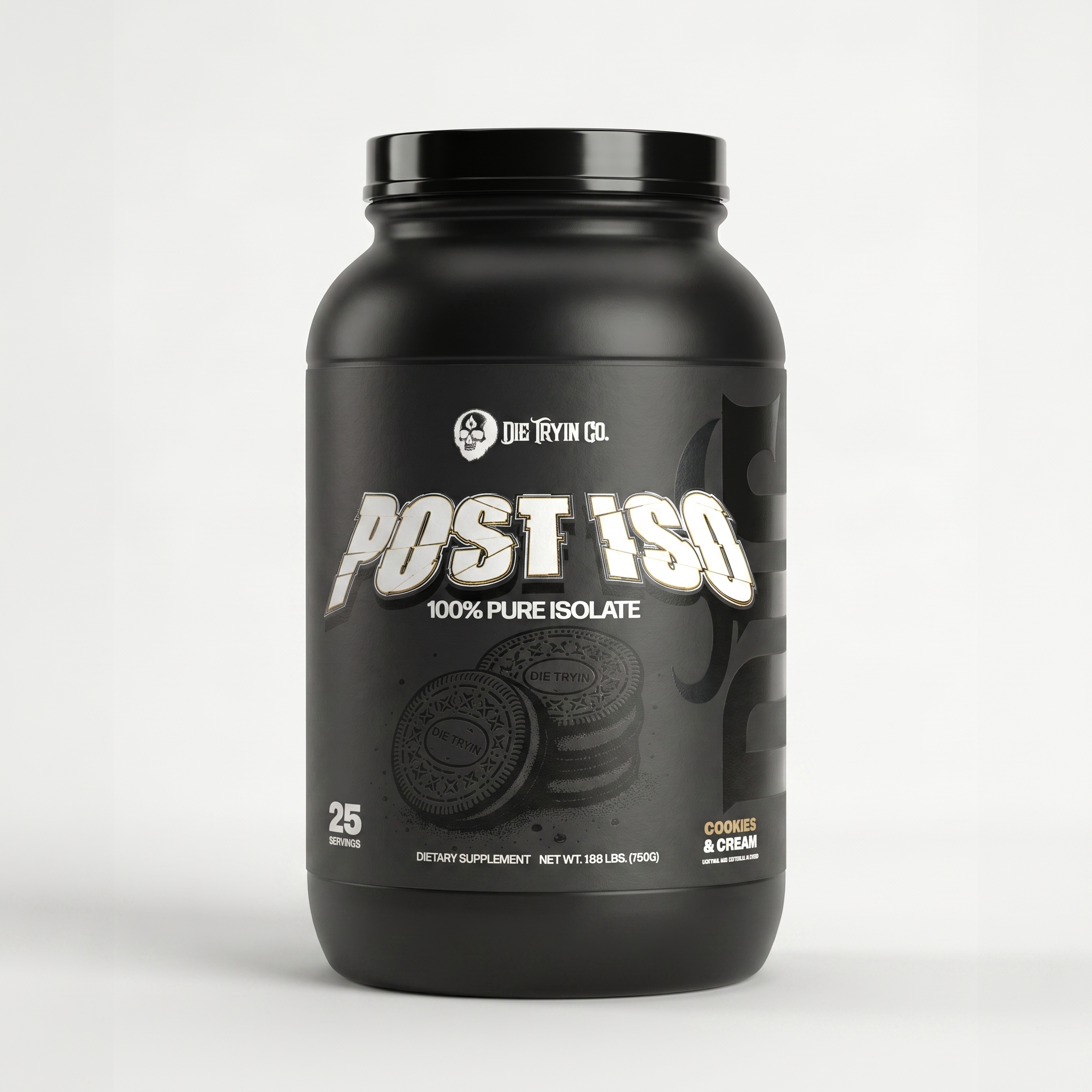
- Post Iso to hit your protein target without hunting down another chicken breast.
- Fuel Point for carbs you can sip through a long session.
- Creatine Monohydrate, 5 g a day, the most researched training supplement there is.
- Ghillie Greens when your vegetable intake needs backup.
- DTC Athletic Tee for the days you go earn the carbs.
- Not sure where you fit? Take the supplement quiz.
Carbs are not the enemy. Undereating your training is. Pick your number, hit it, and stop letting the internet talk you out of your fuel.
ALWAYS FORWARD.

GEAR THAT FITS THIS POST
The products this article actually talks about. Real doses, disclosed labels, veteran owned.


Read more
The no-BS playbook for losing fat without losing muscle. Energy balance, protein, training, sleep, and the supplements that actually help.

The afterburn effect is real, and it is far smaller than the industry claims. Here is what cardio and lifting each actually contribute to your metabolism.

The complete athlete's guide to fueling: carbs for output, protein for recovery, fats for hormones. Daily targets, timing, and the mistakes that kill progress.

Protein does more than build muscle. 8 real benefits ranked by evidence strength: satiety, metabolic boost, bone density, sarcopenia prevention, and more.

The app you pick matters far less than whether you log consistently and weigh your food. Here is what actually decides it.

You can't out-train a bad diet. Here's the no-BS guide to macros — what they are, why they matter, and how to count them so you actually hit your goals.