




Glycerol
By Jon Klipstein, U.S. Army Combat Veteran & Founder of Die Tryin Co.
Science reviewed by Onur Oncer, BS Physiology and peer-reviewed published researcher.
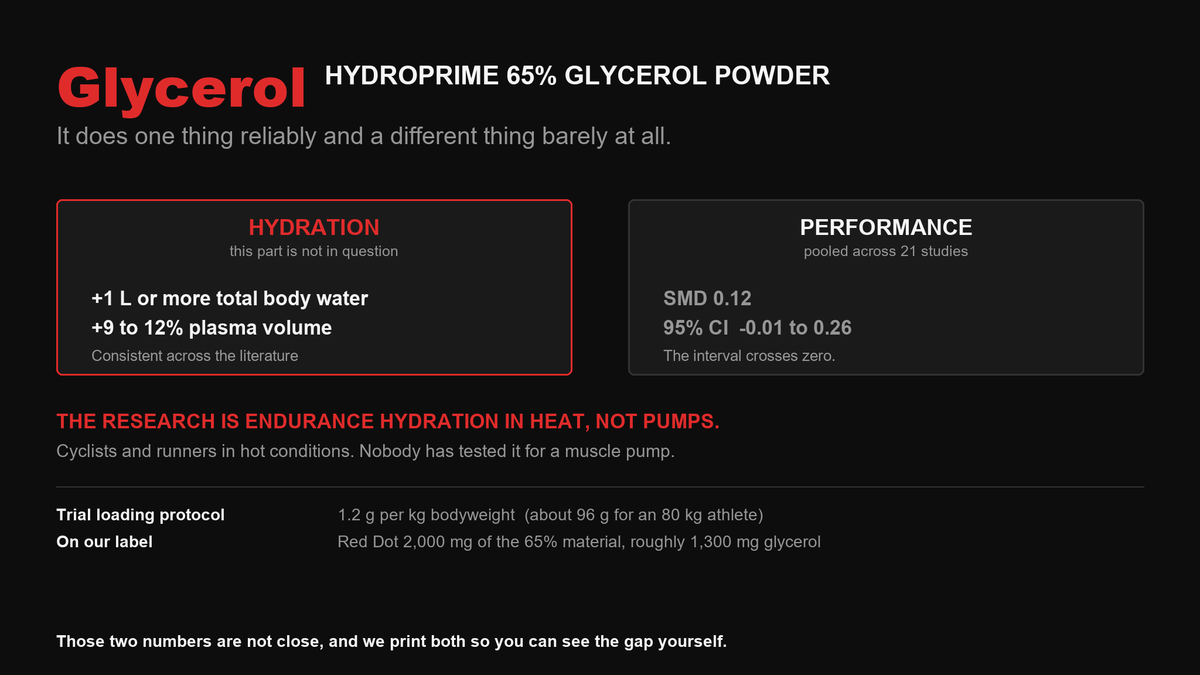
IT HOLDS WATER. THAT IS THE PART THAT IS SETTLED.
Glycerol is a three-carbon sugar alcohol, the backbone of every triglyceride in your body. Taken with fluid it acts as an osmolyte: it creates an osmotic gradient in the circulation that favors holding water rather than passing it as urine. More total body water, expanded plasma volume.
Most people get this wrong. The category sells glycerol as a pump ingredient. The human research is almost entirely cyclists and runners working in heat, and what it measures is fluid retention and time to exhaustion. That is a hydration literature, not a hypertrophy one. We formulate on the hydration mechanism, print the dose, and tell you which is which.
Where it sits in the line, exactly as the labels print it:
| Product | Glycerol per serving | Role in the formula |
|---|---|---|
| Red Dot | 2,000 mg HydroPrime® Glycerol Powder (65%) | The hydration component of the stim-free formula |
The "65%" is the raw material: glycerol carried on a stabilizing base, because pure glycerol is a humectant that pulls moisture straight out of the air. Sixty-five percent of 2,000 mg works out to roughly 1,300 mg of glycerol. That same behavior is why a tub of Red Dot clumps, which is a good sign rather than a defect: the ingredient doing the clumping is the ingredient you paid for.
WHAT THE RESEARCH SHOWS
The hydration effect is settled. In the Sports Medicine dosing guidelines, glycerol beverages create an osmotic gradient favoring fluid retention, and increases in body water of 1 L or more are routinely achieved, with reported plasma volume gains running in the 9 to 12% range. Jardine and colleagues (2025, International Journal of Sports Physiology and Performance, 13 trained runners) caught both ends of it in one study: glycerol plus sodium raised fluid retention by 1,189 mL and plasma volume by 9.0%, and did not improve half-marathon time-trial performance in warm conditions.
That split is the whole story. The largest synthesis, a 2021 meta-analysis by Barefoot and colleagues in Medicine & Science in Sports & Exercise pooling 21 studies and 33 effects across 166 subjects, reported a negligible effect on performance: a standardized mean difference of 0.12, 95% CI -0.01 to 0.26. That interval crosses zero, and no subgroup moderated it, not dose, not training status, not heat. A broader meta-analysis of pre-exercise hyperhydration, pooling glycerol and sodium protocols rather than glycerol alone, found a small-to-moderate benefit for time-to-exhaustion (g = 0.31) and time trial (g = 0.25), though not total work.
Where the evidence stops: this is endurance hydration research, run in heat, on cyclists and runners. The Barefoot sample was 98% men, and the hyperhydration review flags the same near-absence of women, elite athletes and running protocols. What has not been run is a trial of glycerol measuring a resistance-training outcome: muscle fullness, pump, or hypertrophy. The osmotic mechanism is why glycerol earns a place in a hydration-forward formula. It does not give you a pump number, and there is not one to quote.
| Dose | What the number counts | |
|---|---|---|
| In the hyperhydration trials | 1.2 g per kg bodyweight in 26 mL/kg of fluid over 60 minutes (about 96 g for an 80 kg athlete) | Glycerol as the loading protocol dosed it |
| On our label | 2,000 mg (Red Dot), roughly 1,300 mg glycerol | The HydroPrime® 65% material, as printed |
Those two numbers are not close, and you should get that from us rather than work it out later. The hyperhydration protocol is its own practice: a large load in roughly two liters of fluid, an hour before an endurance event in the heat. The body-water and plasma-volume figures above belong to that protocol, not to a pre-workout scoop. Red Dot's 2,000 mg is printed as the material with its percentage so you can run the arithmetic yourself: a mechanism worth formulating on, human data reported honestly, and a label you can check.
HYDRATION IS THE PART LIFTERS SKIP
Water is the cheapest performance variable in the building, and the one most people ignore until a session falls apart. Those same guidelines note that dehydration alters cardiovascular and thermoregulatory function and can limit endurance capacity once fluid loss passes about 2% of bodyweight. Glycerol is one lever; sodium and the rest of the panel matter more day to day. The electrolytes breakdown covers what you lose in a session, and the hydration guide covers the habit underneath it.
FREQUENTLY ASKED QUESTIONS
What is glycerol?
A three-carbon sugar alcohol, and the backbone of every triglyceride in your body. As a supplement it works as an osmolyte: taken with fluid, it creates an osmotic gradient that keeps water in your system instead of passing it as urine.
Does glycerol improve pumps?
No trial has measured that. The glycerol literature is endurance hydration in heat, tracking fluid retention and time to exhaustion in cyclists and runners. The osmotic mechanism is why glycerol belongs in a hydration-forward formula, but muscle fullness has never been an endpoint, so there is no pump number to report.
What dose does the research use?
The hyperhydration protocol is 1.2 g of glycerol per kg of bodyweight in 26 mL/kg of fluid, over 60 minutes ending 30 minutes before exercise. Red Dot lists 2,000 mg of HydroPrime® Glycerol Powder (65%), roughly 1,300 mg of glycerol. Trials dose a loading protocol, labels count the material, and we print the label form exactly.
Does glycerol have side effects?
The Sports Medicine guidelines report that side effects are rare, listing nausea, gastrointestinal discomfort and light-headedness when they do occur. Those come from the large loading doses used in hyperhydration research, not from formula-level amounts.
READY TO GEAR UP?
Every dose above is printed on the label, in the form you actually receive. Glycerol lives in Red Dot, our stim-free formula. See every ingredient we use in the Ingredient Index, or take the 60-second quiz to match a formula to your training.
ALWAYS FORWARD.
Read more
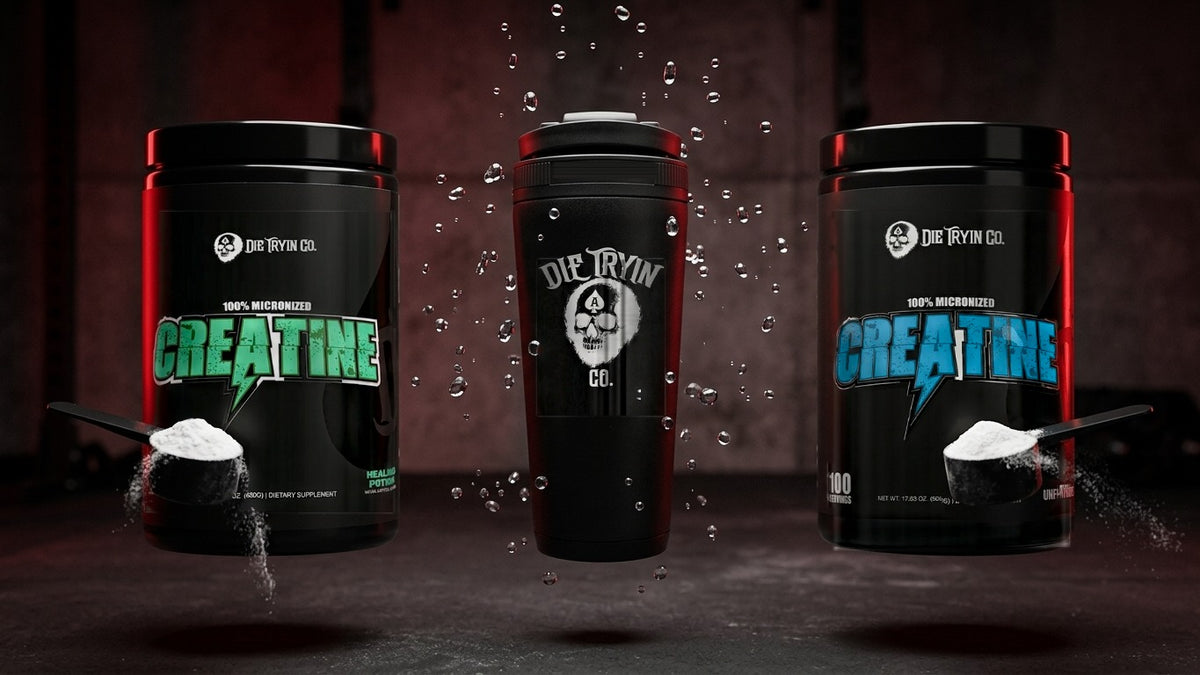
Flavor doesn't change what creatine does; taking it every day is what counts. How to pick flavored or unflavored, what to mix it with, and how long it lasts once mixed.
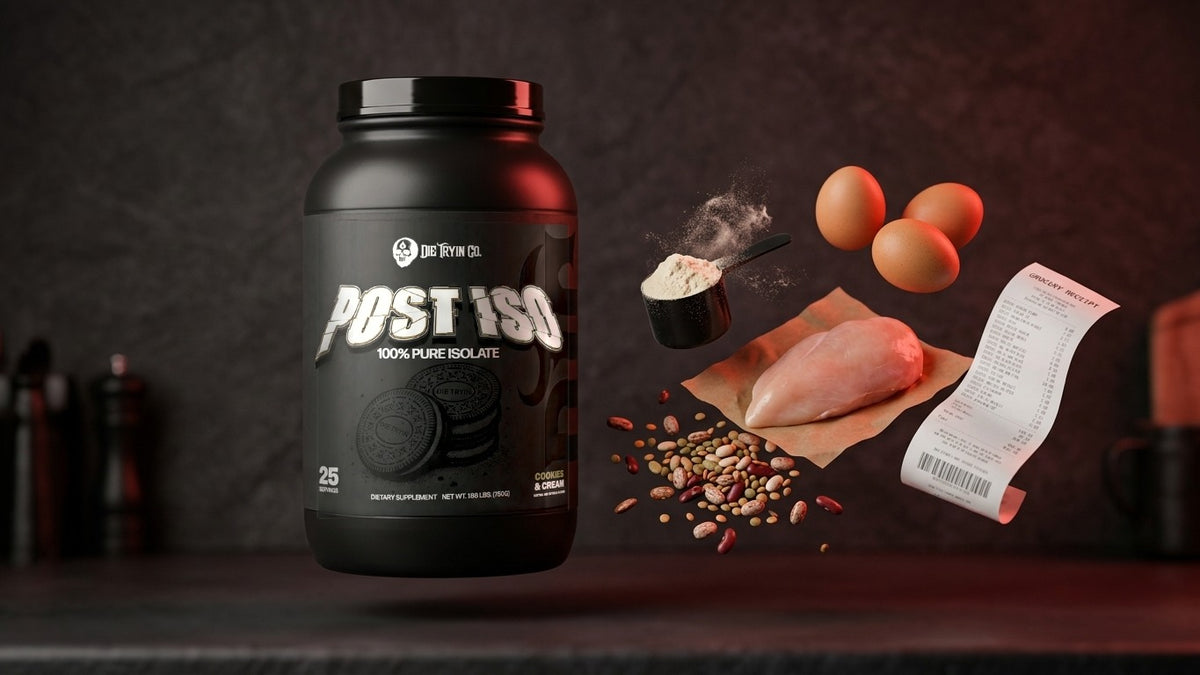
Whey protein concentrate now costs more than four times its early-2023 low. Here is what is driving it, what the 2027 forecasts actually say, and how to pay less per gram of protein without getting...
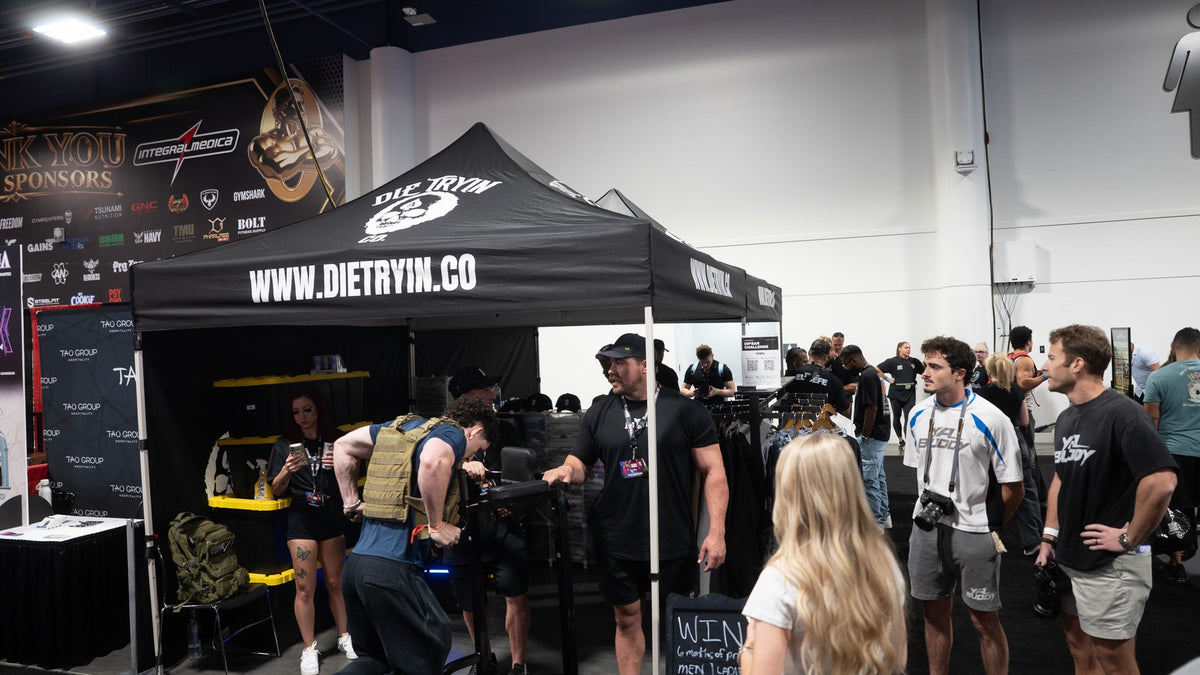
Four days, 1,400 miles on the road, 17 new products and 500 new customers. Here is what went down at the Die Tryin Co. booth at the 2026 Olympia World Fitness Expo.
Two tubs both say 9 g of citrulline. One gives you 9 g, the other gives you 6 g. The 2:1 ratio explained, plus the 2024 trial that tested whether the malate does anything at all.
The honest case for a multivitamin when you train hard: where the evidence stops, where the gaps are real, and why chelated minerals plus a gut stack change the math.
Most people buy carbs, aminos and electrolytes as three separate tubs. Fuel Point 2.0 is one scoop that does all three jobs, with every dose printed where you can read it.