




Creatine and Gut Health: What the Research Actually Shows
By Jon Klipstein, U.S. Army Combat Veteran & Founder of Die Tryin Co.
Science reviewed by Onur Oncer, BS Physiology and peer-reviewed published researcher.
YOUR GUT RUNS ON CREATINE TOO
Most people get this wrong. The internet tells two stories about creatine and gut health. One says creatine wrecks your stomach. The other sells it as a gut fix. Both go too far.
Here's the answer up front. In studies on people, stomach trouble showed up about as often on creatine as on a placebo, a look-alike with no creatine in it. That held at normal doses and well above them. For gut diseases like colitis (an inflamed colon), lab studies show the cells lining your gut use creatine to keep the gaps between them sealed. Animal studies point the same way. No one has run a trial on people with those diseases yet.
Below, every claim tells you what it rests on: studies in people, studies in mice, or no testing at all. You will also see who should talk to a doctor first.
| THE QUESTION | WHAT THE RESEARCH SHOWS | EVIDENCE LEVEL |
|---|---|---|
| Does creatine upset your stomach? | Across 685 studies, about 5.5% of people on creatine had stomach trouble vs about 4% on placebo. That gap is small enough that it could just be chance | Hundreds of studies in people, combined |
| Does one big serving matter? | One 10 g serving led to more diarrhea. The same 10 g split into two 5 g servings came out the same as placebo | One study in people, with a placebo group |
| Does your gut lining use creatine? | Yes. Gut-lining cells use creatine for energy the same way muscle does, right at the seals that hold the cells together | Lab-grown cells + human gut tissue samples |
| What about colitis and Crohn's? | Both are diseases that inflame the gut. In mice and rats, colitis made in the lab was milder with creatine. In people: one patient's story, and the only trial on the U.S. government's study list was called off before anyone signed up | Animals + one patient's story. No trial in people yet |
| What about IBS? | No one has studied creatine in people with IBS (irritable bowel syndrome) | Not tested |
| Leaky gut or gut bacteria (the microbiome)? | No study in people has checked either one on creatine supplements | Not tested in people |
WHAT DOES CREATINE DO TO YOUR GUT?
The cells that line your gut use creatine the same way your muscles do: to recharge their energy. It is the same quick-recharge system that refuels your muscles between hard sets (how that energy system works in muscle). A 2013 study found the enzymes that run this system (think of them as the workers) sitting right at the seals between gut cells. The cells needed them to build those seals (Proceedings of the National Academy of Sciences).
Creatine needs a door to get into a cell. In gut cells, that door sits right around those seals. When researchers shut the door in lab-grown human gut cells, the seals leaked. The cells also built a weaker barrier and healed scrapes more slowly. Researchers also bred mice that were missing the door. Tiny bits of their gut, grown in a dish, built a weaker barrier too (a 2020 gut-cell study). That was a lab experiment, not a test of a supplement.
Then there is the creatine you eat. Take a man who weighs about 155 pounds (70 kg). He needs about 2 g of creatine a day. If he eats meat, up to half of that comes from food, and his body makes the rest. Creatine you eat goes through your gut and liver first, so your gut sees it before most of your body does (Amino Acids journal, 2016).
CAN CREATINE CAUSE DIGESTIVE PROBLEMS?
Stomach upset and loose stools can happen. But in studies, they showed up about as often on placebo. A 2025 safety review combined 685 studies in people. It covered about 12,800 people on creatine and 13,500 on placebo. About 5.5% of people on creatine reported stomach trouble, vs about 4% on placebo. Count the people, and that gap could just be chance. Count the studies instead, and slightly more creatine studies had at least one person with a stomach complaint. That gap was unlikely to be chance. Either way, any extra stomach trouble is small. Keep in mind these studies averaged about 12.5 g a day for about 65 days. That is two and a half times a normal 5 g serving.
Full disclosure on that review: its lead author chairs AlzChem's scientific advisory board, the company's panel of science advisers. AlzChem makes Creatine Monohydrate. It also paid the journal's fee to publish the review (some journals charge a fee to publish a paper). Worth knowing when you weigh it.
Serving size is where stomach trouble does show up. Look at a 2008 study of 59 top-level male soccer players. It ran 28 days with three groups. One group took 10 g of creatine a day in one serving. A second group took the same 10 g a day as two 5 g servings. A third group took a placebo. Neither the players nor the researchers knew who got what. Here is how often each group had diarrhea:
- One 10 g serving: about 56%. That was higher than both other groups, by a gap unlikely to be chance.
- Two 5 g servings: about 29%. That is a bit lower than placebo, but the study found no real difference on stomach trouble.
- Placebo (no creatine): 35%. So about a third of these players got diarrhea with no creatine at all.
What about bloating? Much of what people call creatine bloat is water. Your muscles store water along with the creatine, mostly during a loading week (a first week of extra-big doses). That is the scale moving, not your gut. For everything else, see the common creatine side effects.
HOW TO TAKE CREATINE WITHOUT STOMACH TROUBLE
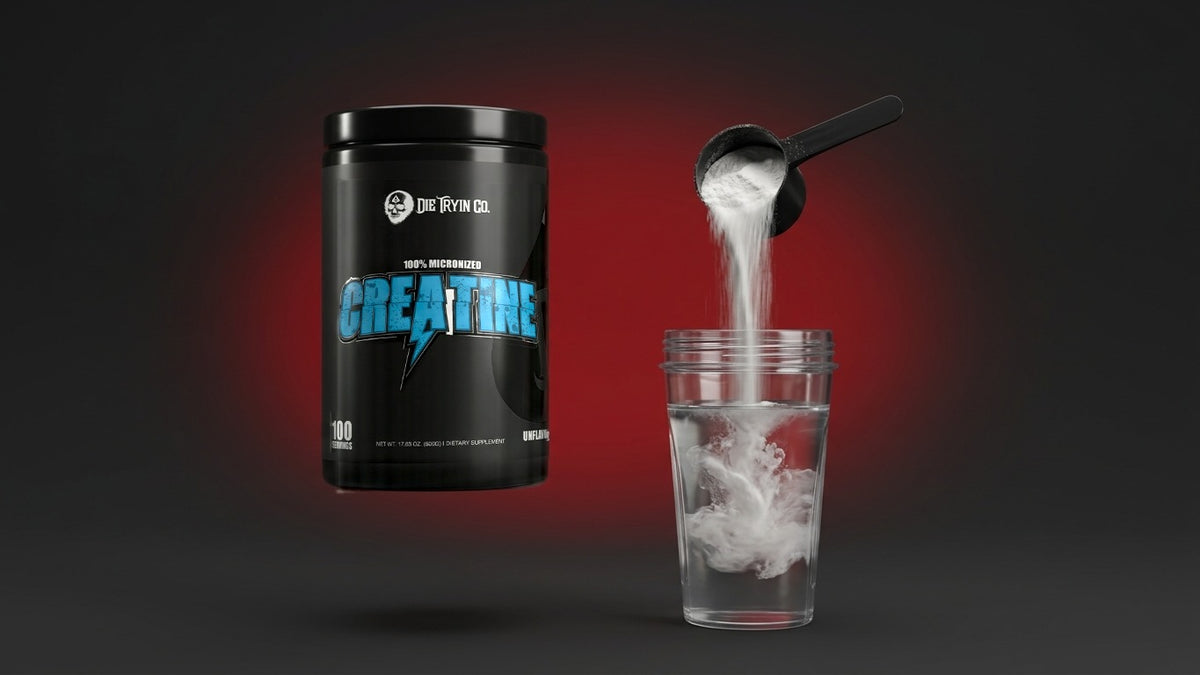
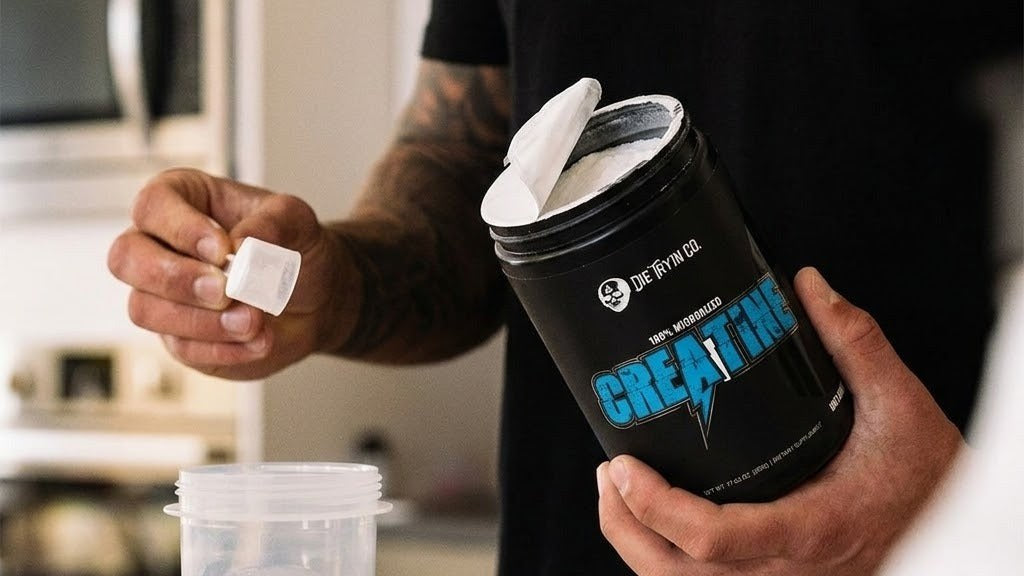
Here are the label directions on Die Tryin Co. Creatine. Mix 1 scoop once a day. One scoop is 5,000 mg (5 g) of Creatine Monohydrate. Use 10 to 12 oz of water or your favorite sports drink. Then:
- One scoop a day. That is the same 5 g the two-servings group of soccer players took at each serving, and that group matched placebo.
- Loading? If you load (about 20 g a day for a week), split it into 5 g servings through the day. Never take it as one big dose.
- Touchy stomach? Take it with a meal. It is a practical move, but no trial has tested it. More on taking it with food or on an empty stomach.
- Red flags go to a doctor. Pain that sticks around, blood in your stool or weight loss you can't explain means a doctor visit. That is not a creatine problem to fix on your own.

CREATINE AND IBD: WHAT THE ULCERATIVE COLITIS AND CROHN'S RESEARCH SHOWS
IBD (inflammatory bowel disease) covers two main conditions. Ulcerative colitis inflames the colon, and Crohn's can inflame any part of the gut. Start with human tissue. The 2020 gut-cell study also checked colon samples from 30 people with Crohn's and 27 with ulcerative colitis. It compared them with samples from 30 people without IBD. People with ulcerative colitis had fewer creatine doors in that tissue. So did people with Crohn's that was not flaring up at the time. The 2013 study found that the genes that build those creatine workers were less active in gut tissue from some IBD patients. A 2024 genetics study looked at gene versions that push blood creatine naturally higher. Those gene versions went with lower odds of ulcerative colitis (the study's odds ratio was 0.45). That is about the creatine levels you are born with, not about taking a supplement (International Immunopharmacology journal, 2024).
Then animals. Researchers gave mice and rats creatine while using chemicals to cause colitis. Creatine made it milder in mice (the 2013 study, plus mouse tests in the 2024 gene study) and in rats (Food & Function journal, 2025). Mice bred so they cannot make their own creatine got colitis more easily. Adding creatine made it milder (Proceedings of the National Academy of Sciences, 2017). Remember, colitis caused by chemicals in a mouse or rat is a lab imitation, not the disease people get.
Then one person. A case report is a write-up of a single patient. This one describes a 33-year-old man with Crohn's at the end of his small intestine (American College of Gastroenterology case reports journal, 2016). Doctors scored his gut with a camera exam (a scope), where a lower score is better. His score was low while he took creatine. It got worse over 4 months off creatine. It improved again when he went back on. That is one patient with no comparison group. And the creatine he took was creatine HCl, a different form, not Creatine Monohydrate. The authors noted that Crohn's flares up and settles down on its own, too.
WHERE THE HUMAN EVIDENCE STOPS
The gut-lining lab work is why researchers wanted to test creatine in people. The University of Colorado listed a trial on ClinicalTrials.gov, the U.S. government's list of studies. The plan: Creatine Monohydrate vs placebo in people with mild to moderate ulcerative colitis. It would run 8 weeks and be judged by a camera exam. Its status today: withdrawn. It was called off with 0 people signed up (study ID NCT02463305). Two review papers argue creatine deserves a trial in people with gut inflammation (Nutrients journal, 2021; Nutrition journal, 2026). So any brand selling creatine as a colitis fix is pointing to mice, rats and one patient.
If you have ulcerative colitis, Crohn's or IBS, talk to your GI doctor (a gut specialist) before adding creatine. Never use it in place of the treatment you are on. Even the team behind that trial planned to keep certain people out. That meant anyone whose creatinine was above normal. (Not a typo: creatinine is a waste product your kidneys clear, and blood tests measure it.) It also meant anyone on drugs that can strain the kidneys. Those included:
- Anti-inflammatory painkillers like ibuprofen (NSAIDs)
- Water pills (diuretics)
- Two kinds of blood pressure drugs (ACE inhibitors and ARBs; ask your pharmacist if yours is one)
- The immune-lowering drugs cyclosporine and tacrolimus
LEAKY GUT AND THE GUT MICROBIOME: WHAT HAS BEEN MEASURED
Leaky gut first. It means your gut lining lets more stuff pass from your gut into your body than it should. The seal research above was done in cells and mice. No study in people has measured whether creatine supplements change how leaky the gut lining is. The withdrawn trial would have measured it, as a side question. Athletes' gut lining does get leakier during long, hot sessions. See exercise and leaky gut.
Gut microbiome next: the mix of bacteria living in your gut. No study in people has measured how creatine supplements change it. In mice, the research so far looks at it the other way around: how gut bacteria change creatine. In one study, mice fed only in the daytime ended up with about nine times as much creatine in their gut. Part of that came from a shift in their gut bacteria (Gut Microbes journal, 2025). If gut health is the goal, fiber and fermented foods are the tools with research in people behind them.
THE BLOOD TEST YOUR DOCTOR NEEDS TO KNOW ABOUT
Creatine raises creatinine on a blood test. Two 2026 reviews in kidney journals combined the results of many studies (Journal of Renal Nutrition; International Urology and Nephrology). On average, creatinine went up by about 0.13 to 0.14 points (mg/dL, the unit on your lab report). Doctors often estimate kidney filtering from creatinine, so creatine can make your kidneys look worse on paper. But when researchers measured kidney filtering directly, with a tracer (a substance they can follow through the kidneys), they found no clear change. The full breakdown is in the creatinine myth.
If you have kidney disease or take a medication your doctor checks with blood work, clear creatine with your doctor first. Tell whoever orders your labs that you take it, too. If you are pregnant, managing a medical condition or taking medication, clear any supplement with your doctor first.
FREQUENTLY ASKED QUESTIONS
Is creatine good or bad for your gut?
Not bad for healthy people: across 685 studies, stomach trouble showed up about as often as on placebo. Your gut lining uses creatine, but no trial in people has tested whether a creatine supplement improves gut health, so start with these 8 gut health tips.
Can creatine trigger IBS?
No study has tested creatine in people with IBS, as a trigger or as help, so talk to your GI doctor first. If you have IBS-D (the type where diarrhea is the main symptom) and your doctor clears it, keep each serving at 5 g. In the only study that tested serving size, done in healthy soccer players, one 10 g serving raised diarrhea.
Can creatine mess with bowel movements?
In one study, loose stools went with one big 10 g serving, while two 5 g servings a day matched placebo. A U.S. nutrition survey (2005 to 2010) found people who ate more creatine from meat had lower odds of long-term constipation and no link to diarrhea. That does not prove the creatine caused it, and it was creatine from food, not a supplement (Frontiers in Nutrition journal, 2025). If loose stools keep up after you switch to 5 g servings, stop taking creatine and talk to your doctor.
Is creatine safe if you have ulcerative colitis or Crohn's?
No trial in people has answered that yet, and the only one listed on ClinicalTrials.gov was withdrawn before anyone signed up. Your GI doctor makes this call, with your kidney blood work in hand.
Does creatine turn into creatinine in your gut?
Barely: less than 1% of Creatine Monohydrate turns into creatinine as you digest it (Journal of the International Society of Sports Nutrition, 2021). The real breakdown risk is a product sitting wet and acidic (sour) on a shelf, like some gummies (where creatine actually breaks down). The creatinine on your blood test comes mostly from the creatine stored in your muscles.
What is the best creatine for a sensitive stomach?
Plain, single-ingredient Creatine Monohydrate. About 95% of the 685 studies in that safety review used it, so it is the form with the stomach data behind it. HCl and the other forms are marketing. Want nothing else in the scoop? Go with unflavored creatine. The full checklist covers what to look for in a creatine.
READY TO GEAR UP?
Die Tryin Co. Creatine has one line on its Supplement Facts panel: 5,000 mg of Creatine Monohydrate per scoop. 100 servings, third-party tested. Pick Healing Potion, Unflavored, Cherry Limeade or Forbidden Fruit, and shake it in a Die Tryin Co. Sportshaker. Real doses of real ingredients. Not sure what fits your stack? Take the quiz.
ALWAYS FORWARD.

GEAR THAT FITS THIS POST
The products this article actually talks about. Real doses, disclosed labels, veteran owned.


Read more
Kidney damage, steroids, hair loss, bloating — creatine is buried under gym myths. Here's the truth on each one, backed by what the research actually shows.

Pre-workout? Post-workout? With food? The truth about creatine timing is simpler than the internet makes it — here's what actually matters.

You do not grow from what you eat. You grow from what you absorb, and that is a gut problem.

Your gut runs more than your digestion. Here are 8 day-to-day tips — diet, hydration, sleep, stress, and probiotics — to support a healthier gut.

Not all creatine is worth your money. Here's exactly what to look for in the best creatine — and the overpriced, overhyped forms to walk right past.

The supplement industry sells creatine HCL as an upgrade. The honest answer: monohydrate is the proven, better-value gold standard. Here's the real comparison.