





Cluster Dextrin vs Carb10: Which Intra-Workout Carb?
By Jon Klipstein, U.S. Army Combat Veteran & Founder of Die Tryin Co.
Science reviewed by Onur Oncer, BS Physiology and peer-reviewed published researcher.

TWO CARBS, TWO DIFFERENT JOBS
Listen up. Cluster Dextrin and Carb10 get sold to you as one thing: "premium carbs." They are not one thing. They are two different molecules with two different digestion curves, two very different evidence files, and two different reasons to be in a scoop.
There is a third name in this conversation, and it is the one in our tub: SusCarb® Dextrin. Here is the sentence that saves you the rest of the article if you only want the answer: SusCarb and Cluster Dextrin are the same family of molecule, built to different specifications. Both are highly branched cyclic dextrin, or HBCD. Carb10 is not in that family at all, because it is pea starch and not a dextrin.
That word specifications is doing real work, and it is the part the category skips. HBCD is a category, not a single ingredient. Two things vary inside it, and they happen to be the two things that make HBCD worth buying: how heavily branched the molecule is, and how uniform the molecules are in size. Glico and Zymebase land in different places on both. We will show you where, and we will be equally clear about what nobody has proven yet.
One of them is a high-molecular-weight glucose polymer engineered to clear your stomach fast. The other is a pea starch built to release slowly. Put plainly, one is designed to get in quick and the other is designed to stay around. That is the entire argument for running both.
Below is what each one actually is, what the peer-reviewed human research does and does not show, and the absorption ceiling almost nobody selling carb powder wants to talk about. Basics beat hype, and the basics here are more interesting than the marketing.
Why we are writing this, and what we changed
We used to run both of these carbs. The original Fuel Point paired 20 g of Cluster Dextrin with 6 g of Carb10: a fast carb and a slow one, exactly the two-speed logic this article describes.
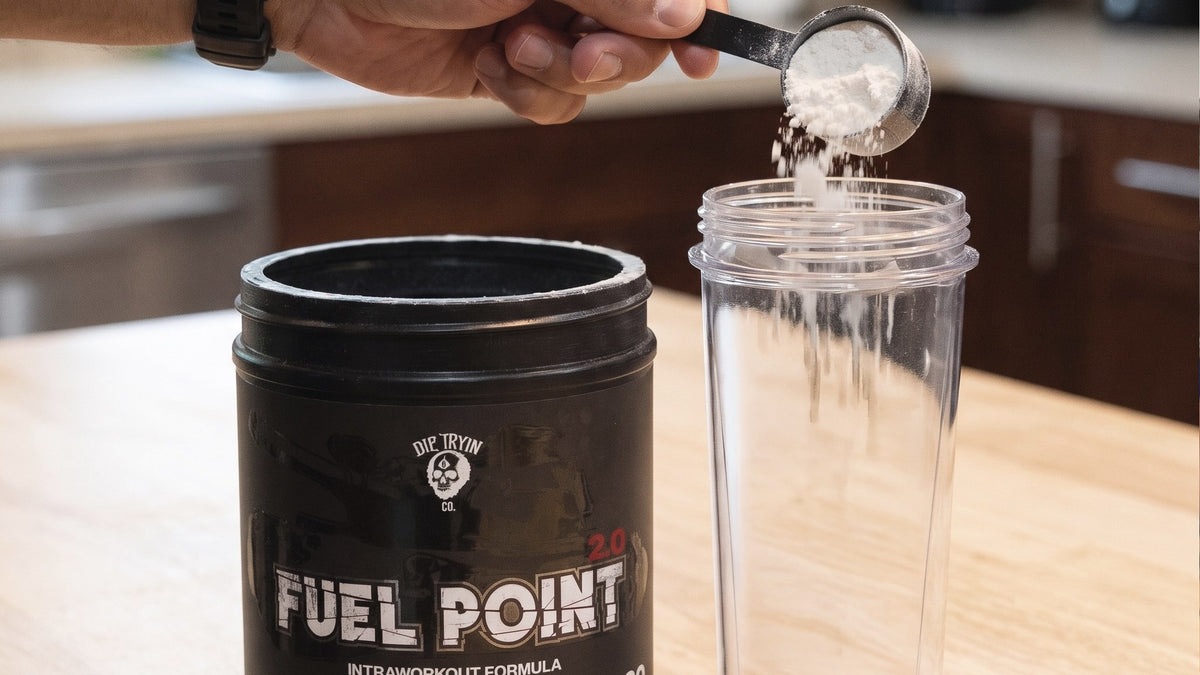
Fuel Point 2.0 does something different. It runs 24 g of SusCarb® Dextrin and no Carb10.
Two decisions there, and neither was cosmetic.
We changed which HBCD we use. Not because Cluster Dextrin is bad, it is the ingredient that built this category. Because Zymebase specifies SusCarb with a higher branching ratio and a tighter molecular weight distribution than the HBCDs already on the shelf, and those are precisely the two numbers that determine whether a "premium carb" behaves like one. The section below breaks down what both of those mean and why they change how the powder sits in your stomach.
We dropped the second carb. One carbohydrate instead of two, and the room that freed up went to the part the original Fuel Point was missing entirely: 6,750 mg of complete EAAs and a full electrolyte panel. The carb got better specified. The rest of the scoop got a job.
So this article is not us talking up an ingredient we sell. Half of it is about a carb we no longer use. Read it as the reasoning, then go look at our panel and decide whether the reasoning held up. Full 2.0 breakdown, including why a brand-new branded carbohydrate took so long to source, is in the Fuel Point 2.0 post.
| QUESTION | CLUSTER DEXTRIN (HBCD) | CARB10 (PEA STARCH) | SUSCARB® (HBCD): WHAT WE USE |
|---|---|---|---|
| What it is | Highly branched cyclic dextrin, an enzyme-modified corn starch polymer | A branded starch sourced from peas, high in the slow-digesting fraction | Zymebase's branded HBCD. Same family as Cluster Dextrin, specified with a higher branching ratio and a narrower molecular weight range |
| Behavior in the gut | Heavy molecule, low osmolality, engineered to leave the stomach quickly | Breaks down gradually, blunter blood-glucose curve | Heavy molecule, low osmolality, leaves the stomach quickly. The tighter size range means less of the powder behaves like maltodextrin |
| Human evidence | Small and thin, but it exists. One 2024 randomized crossover in 30 trained-ish lifters | No published human trial on the branded ingredient. Data exists on generic pea starch, at rest | Inherits the published HBCD evidence below. The branching and uniformity claims are Zymebase's specification, not a head-to-head human trial |
| Best job | Carbs you need working now, mid-session, without a brick in your gut | Background fuel across a long session, smoother tail end | The same job Cluster Dextrin does, from a tighter spec sheet. This is the HBCD we run, at 24 g per scoop |
| Honest verdict | Real mechanism, modest and mixed performance data | Plausible mechanism, essentially unstudied in athletes | Same mechanism and evidence base as any HBCD. The difference is how tightly the molecule is built, not what it does in you |
WHAT CLUSTER DEXTRIN ACTUALLY IS
Cluster Dextrin is a trade name for highly branched cyclic dextrin, or HBCD. It is made by hitting amylopectin (the branched half of starch) with a branching enzyme until you get a large, ring-structured molecule. High molecular weight, low osmolality. Osmolality is the part that matters: a solution loaded with small sugar particles pulls water into your gut and sits there. A solution built from fewer, larger molecules does not.
That is the whole engineering pitch, and the mechanism is legitimate. The first published work on it came out of Ezaki Glico's own lab in 1999 (Takii and colleagues, Bioscience, Biotechnology, and Biochemistry), where mice given HBCD emptied it from the stomach significantly faster than a glucose solution and swam significantly longer before exhaustion. Mice. Run by the company that commercialized the ingredient. That is a hypothesis generator, not proof, and anyone quoting it at you as human evidence is selling something.
WHAT THE HUMAN RESEARCH ON HBCD ACTUALLY SHOWS
There are two human studies worth your time, and they cut in different directions.
Furuyashiki and colleagues (2014, Bioscience, Biotechnology, and Biochemistry) ran a double-blind crossover in healthy volunteers comparing just 15 g of HBCD against maltodextrin during endurance exercise. Rating of perceived exertion climbed significantly less on HBCD at both the 30 and 60 minute marks. Small dose, and the published abstract never states how many people were in it. The lead author worked at Ezaki Glico. Take it for what it is.
The better trial is newer and independent of the ingredient's originator. Morenas-Aguilar and colleagues (2024) ran a randomized, double-blinded, placebo-controlled crossover in 30 physically active people, 15 men and 15 women. They sipped 45 g of HBCD in 750 mL across the rest periods of five sets of eight on bench press, bench pull and squat. What they found:
- Zero gastrointestinal complaints. Forty-five grams of carbohydrate mid-session, no stomach trouble. That is the cleanest result in the paper.
- Faster repetition velocity in men, but not in women. Same protocol, same dose, split result. Report the null with the positive or you are cherry-picking.
- No significant change in perceived fatigue, and lactate values the authors describe as comparable or higher, not lower.
- n=30 total, so roughly 15 per sex, and the sex-specific velocity finding rests on those halves, not on 30 people. Several authors were affiliated with a supplement company's research arm.
WHAT CARB10 ACTUALLY IS
Carb10 is a branded carbohydrate sourced from peas. The selling point is the opposite of Cluster Dextrin's: instead of clearing fast, it digests slowly and produces a flatter blood-glucose response.
Here is the honest part. Search PubMed for the branded ingredient by name and you get nothing. Not "weak evidence." Zero results. Every performance claim attached to that trademark traces back to the ingredient supplier rather than to a published trial in athletes.
Generic pea starch has been studied, and the findings support the mechanism if not the marketing. Perreau and colleagues (2023) measured native pea starch at 30% slow-digestible starch and ran a crossover in 13 healthy adults using 25 g portions of available carbohydrate. Glucose response was significantly lower than maltodextrin, with no significant difference in gastrointestinal symptoms. Worth noting: it was a non-blinded design, the participants were sitting still rather than training, the sample was 13 people, and most of the authors work for a pea starch producer. It tells you pea starch digests slower. It does not tell you it makes you faster.
THE ABSORPTION CEILING NOBODY SELLS YOU
This is the part that reframes the whole conversation. Both of these ingredients are glucose polymers. Cluster Dextrin is glucose. Carb10 is glucose. By the time either reaches your intestinal wall, they are the same monosaccharide knocking on the same door, and that door has a fixed width.
Glucose crosses the gut wall on the SGLT1 transporter, and that route saturates. In their Sports Medicine review, Cermak and van Loon (2013) laid out the numbers most athletes never hear:
- 60 g per hour is the advised intake for prolonged exercise lasting 2 to 3 hours, which is roughly where maximal exogenous glucose oxidation tops out.
- Up to 90 g per hour is possible for well-trained endurance athletes competing beyond 2.5 hours, but only with multiple transportable carbohydrates, specifically around 1.2 g/min of glucose plus 0.6 g/min of fructose.
- Carbohydrate during exercise can significantly improve endurance performance in sessions past roughly two hours at moderate-to-high intensity.
- Even 45 to 60 minute hard efforts may benefit from small carbohydrate intakes, and the proposed mechanism there sits in the central nervous system rather than in your muscle glycogen.
Read that second bullet again. Fructose uses a different transporter, which is why pairing it with glucose raises the ceiling. Molecular weight does not. Changing the shape of the polymer changes how fast it leaves your stomach. It does not add a second lane to the highway. Any label promising 100+ grams per hour of glucose-only carbohydrate is promising something your intestine is not built to do.
SO WHY RUN BOTH?
Because comfort and pacing are real problems, and this pairing addresses those. It is not a bigger-number play, it is a smoother-curve play.
Cluster Dextrin handles the front end. It exits the stomach quickly and gets glucose moving while you are still in the middle of the work. Carb10 handles the back end, trickling in and keeping the curve from spiking and dropping out from under you at minute seventy. Fast in, slow out. Two release rates from one scoop, all landing inside the ceiling the research actually supports.
That two-speed logic is why an intra-workout carbohydrate product like Fuel Point exists at all, and that product gets its own breakdown elsewhere on the blog. For the timing framework around any intra-workout carb, read our pre, intra and post-workout guide. Shopping for the session itself? Start with our intra-workout supplements.
HOW TO ACTUALLY USE THEM
| SESSION | DO YOU NEED INTRA CARBS? | PLAY |
|---|---|---|
| Under 60 min lifting | Usually not, if you ate | Water and electrolytes. Fix the pre-workout meal first |
| 60 to 120 min hard training | Can help, especially high volume | 25 to 45 g sipped across the session, not slammed |
| 2 to 3 hr endurance | Yes | Work toward ~60 g/hr and pair with SEND IT Sport |
| Past 2.5 hr | Yes, and the ceiling matters | Add a fructose source from food or gels to get past 60 g/hr |
Sip, do not chug. The 2024 trial that reported no gut complaints had subjects taking 50 mL at a time before each set, which is the opposite of drinking 45 g in two minutes. Mix it thin, start on the low end, and train your gut the way you train everything else: gradually. Dial in the surrounding meals with our carb timing breakdown and the athlete's guide to fueling, and keep hydration handled, because a carb drink that is too concentrated is a hydration problem before it is a fuel problem.
WHERE SUSCARB FITS, AND WHAT WE ACTUALLY USE
There is a third name you will run into, and it is the one in our own tub: SusCarb® Dextrin, produced by Zymebase Inc.
Here is the part the category tends to blur. Cluster Dextrin and SusCarb are both highly branched cyclic dextrin, so everything in the research section above applies to both, including the honest caveat that the human evidence is one small crossover trial and not a mountain. But "both are HBCD" is where most write-ups stop, and stopping there is how you end up thinking the only difference is the label.
The two numbers that separate one HBCD from another
Every HBCD is short chains of glucose joined end to end by alpha-1,4 bonds, with alpha-1,6 bonds forming the branch points that hang one chain off another. Change how often those branch points occur and you change the shape of the whole molecule. Two specifications fall out of that:
- Branching ratio. More alpha-1,6 branch points means a tighter, more globular molecule with more chain ends exposed. That compact shape is the reason HBCD carries so much weight per particle while keeping osmolarity low, which is the entire mechanism behind "heavy carb that does not sit in your gut."
- Molecular weight distribution. A wide distribution means the powder is a mix: some genuinely large HBCD molecules, plus a tail of small fragments that behave more like maltodextrin. A narrow distribution means most of what is in the scoop is actually doing the thing you paid for.
Glico's Cluster Dextrin is the original. A branching enzyme cleaves corn amylopectin and re-links it into ring-shaped structures with fixed, short glucose chains. It is a genuinely clever piece of food science and it created this category.
Zymebase specifies SusCarb with a higher branching ratio and a narrower, more uniform molecular weight distribution than the HBCD products already on the market, while keeping the properties that define the category: high molecular weight, low osmolarity, high solubility. In plain terms, they are claiming a more heavily branched molecule and less variation from particle to particle.
Now the part we are not going to skip. That is a published specification from the manufacturer, not a head-to-head human trial. Nobody has put SusCarb and Cluster Dextrin side by side in a lab with athletes and measured a winner. Anyone telling you one out-performs the other in the body is selling, not citing. What we can tell you honestly is what we did: we read both spec sheets, we picked the tighter one, and we are telling you that is the basis for the decision.
Carb10 is the genuine outlier of the three. It is pea starch, not a dextrin, and it behaves differently: slower, lower on the glucose curve, and a different tool entirely.
Fuel Point 2.0 uses 24,000 mg of SusCarb® Dextrin (HBCD) and no Carb10. The original Fuel Point paired Cluster Dextrin with Carb10; that formula has been discontinued. If you are comparing what is on our current panel against the two carbs in this article, that is the honest mapping: we stayed in the HBCD family and moved to a tighter specification inside it. We wrote up the full 2.0 formula, including why sourcing a brand-new branded carbohydrate delayed the launch, in the Fuel Point 2.0 breakdown.
THE HONEST SCORECARD
- Well established: carbohydrate during long, hard sessions improves endurance performance, and the intake targets are backed by a large body of work.
- Supported but thin: HBCD was well tolerated at 45 g mid-session and moved repetition velocity in men in one 30-person crossover, with no effect in the women.
- Mechanistic only: pea starch digests slowly and blunts the glucose curve at rest, in a 13-person non-blinded trial authored largely by producers.
- Preclinical only: the faster-gastric-emptying-plus-longer-endurance story, which comes from mice and from the ingredient's own commercializer.
- Marketing: any claim that a premium carbohydrate lets you absorb more grams per hour than glucose physiology allows.
- Still the biggest lever: total daily carbohydrate intake. Read Do I Need Carbs? before you spend a dollar on a scoop.
FREQUENTLY ASKED QUESTIONS
Is Cluster Dextrin better than maltodextrin?
For stomach comfort at higher doses, the mechanism favors it and the tolerance data looks good. For raw performance, the head-to-head evidence is one small study reporting lower perceived exertion at 15 g, run by a scientist at the ingredient's own manufacturer. Better tolerated is a fair claim. Dramatically more effective is not.
Is Carb10 actually low glycemic?
Research on native pea starch suggests yes, it produces a significantly lower glucose response than maltodextrin. That data comes from 13 seated adults in a non-blinded, industry-authored trial, and it was not run on the branded ingredient. Directionally credible, not proof of a performance edge.
How many grams per hour should I actually take?
Around 60 g per hour covers most sessions in the 2 to 3 hour range. Going higher than that with glucose-only carbohydrate does not appear to increase what you absorb, it increases what sits in your gut. Past 2.5 hours, add a fructose source.
Do I need intra-workout carbs for a 45 minute lifting session?
Probably not, if you ate beforehand. Muscle glycogen is unlikely to be the limiter in a short session. Fix your pre-workout meal and your sleep before you buy a carb powder to solve a problem you do not have.
Will intra-workout carbs ruin a fat-loss phase?
Only if they push you over your calorie target. Carbohydrate around training is a budgeting question, not a moral one. Count them and move on. Our exercise metabolism breakdown covers how your body picks its fuel.
Can I take these with protein?
Yes. Carbohydrate and protein sit fine together after training, and research suggests co-ingesting a small amount of protein alongside less carbohydrate can support similar glycogen repletion rates. Post Iso handles that side of the session.
READY TO GEAR UP?
Fuel the work, do not decorate it:
- Fuel Point for intra-workout carbohydrate on long, hard sessions
- SEND IT Sport for lower-stim endurance work
- Aqua Spike for hydration and electrolytes when the sweat rate climbs
- Post Iso for the protein side of recovery
- Not sure where you fit? Take the quiz and we will point you at the right stack
Consistency beats intensity, and honest fuel beats a clever label. Train hard. Fuel smart.
ALWAYS FORWARD.

GEAR THAT FITS THIS POST
The products this article actually talks about. Real doses, disclosed labels, veteran owned.



Read more

Most people buy carbs, aminos and electrolytes as three separate tubs. Fuel Point 2.0 is one scoop that does all three jobs, with every dose printed where you can read it.

What to take before, during, and after training — and exactly when. The complete pre/intra/post supplement timing guide. No filler, no 12-bottle stacks.

Carb timing matters less than the industry claims and more than the skeptics admit. Here is where the line actually sits.

The complete athlete's guide to fueling: carbs for output, protein for recovery, fats for hormones. Daily targets, timing, and the mistakes that kill progress.
The complete hydration playbook: how much water you actually need, what dehydration does to your performance, and how to hydrate around hard training.

Carbs are not the enemy and they are not strictly essential either. Here is the honest version, and the numbers that actually matter.