

L-Theanine
By Jon Klipstein, U.S. Army Combat Veteran & Founder of Die Tryin Co.
Science reviewed by Onur Oncer, BS Physiology and peer-reviewed published researcher.
THE ONE ENTRY IN THIS INDEX ABOUT AN INGREDIENT WE DON'T USE
L-Theanine is a non-protein amino acid found almost exclusively in tea. It crosses the blood-brain barrier, acts as a low-affinity glutamate receptor antagonist with activity at GABA-A receptors, and lowers tonic alpha-band power on EEG, which researchers read as wider attention rather than sedation.
It gets paired with caffeine because the two hit different targets. Caffeine drives arousal up by blocking adenosine receptors; L-Theanine is hypothesized to blunt the over-arousal riding along. That hypothesis is where every "smooth energy, no jitters" label comes from.
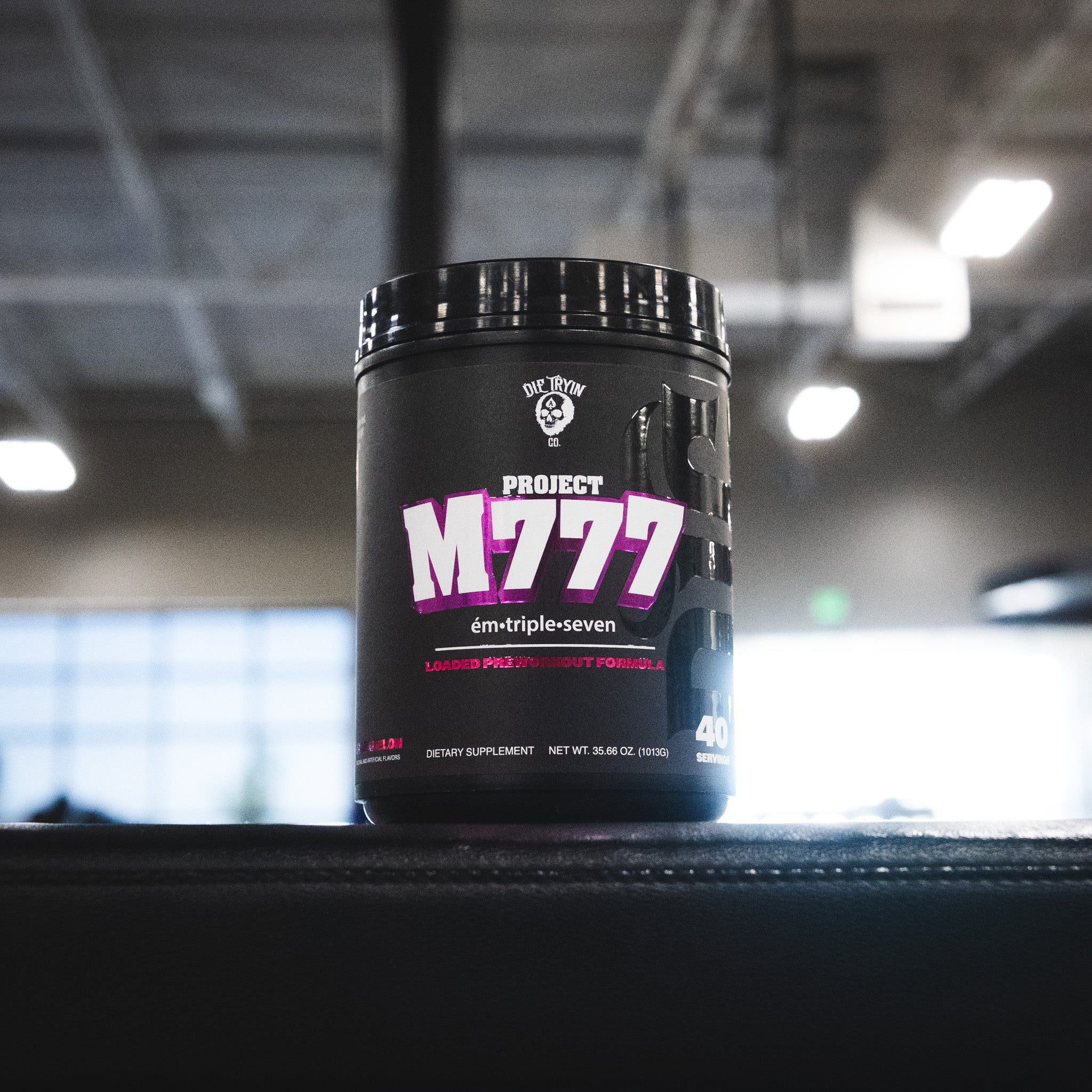
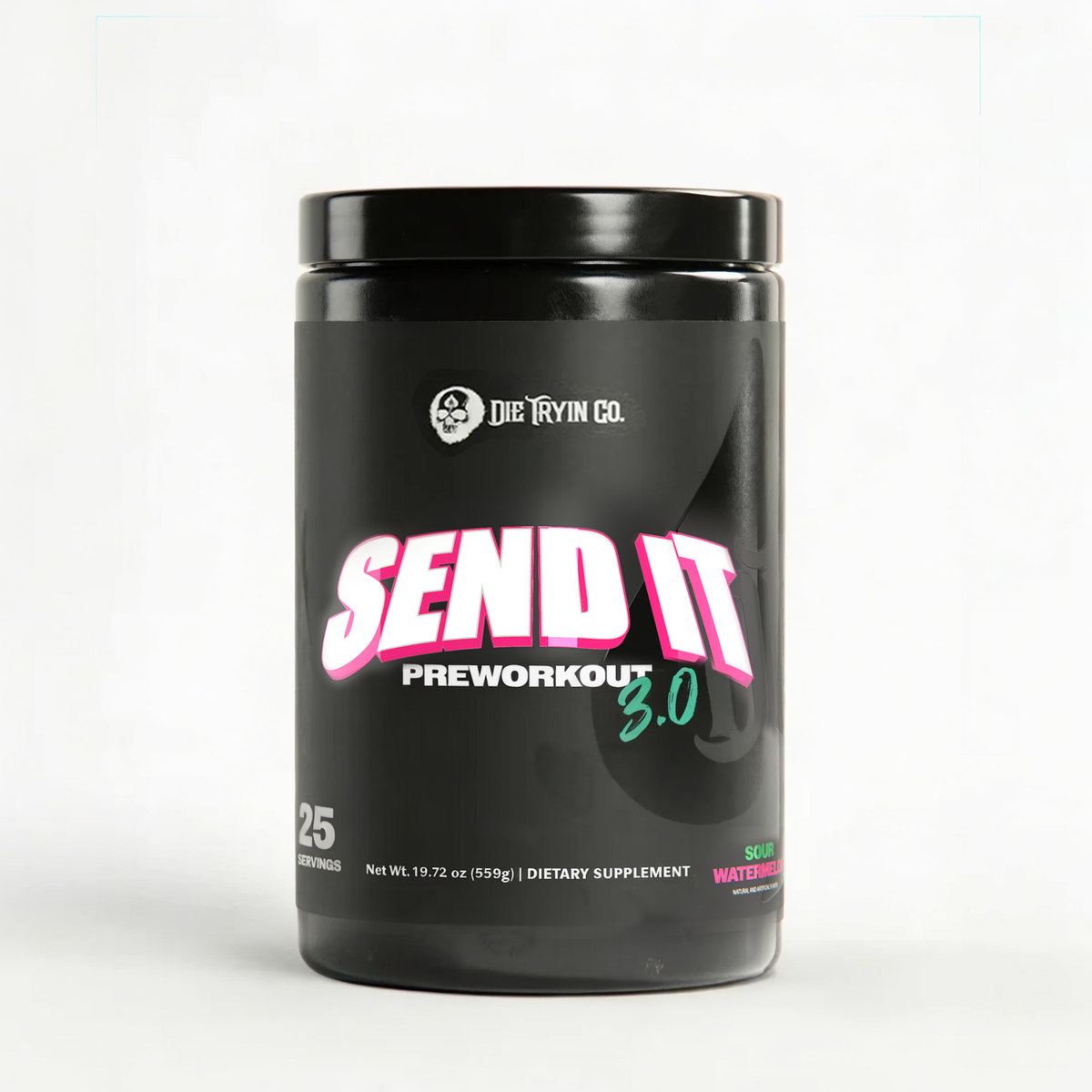
Here's the truth: there is no L-Theanine in anything we sell. Not in SEND IT 3.0, not in Project M777, not in Red Dot, nowhere in the catalog. That is a formulation choice with a real trade-off, so here is the reasoning.
WHAT THE RESEARCH SHOWS
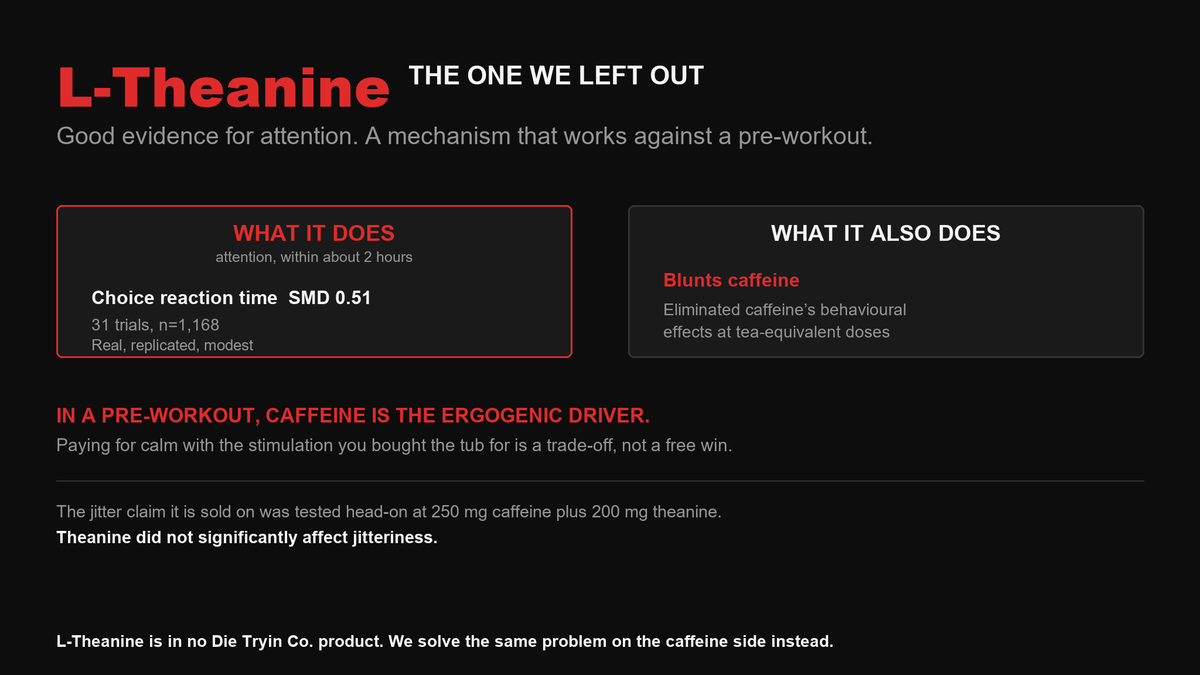
The attention data is genuinely good, and it is independent. A 2026 meta-analysis in Molecular Psychiatry pooled 31 randomized controlled trials and 1,168 participants: a single 200 mg dose 30 to 60 minutes before testing improved choice reaction time, SMD 0.51 (95% CI 0.25 to 0.77), with no serious adverse events. Its authors call that benefit robust, and they earned the word on that endpoint.
Where the evidence stops: the calm-focus promise itself. The one trial that tested it head-on at a training dose of caffeine gave 48 adults 250 mg of caffeine, 200 mg of L-Theanine, both, or neither. L-Theanine antagonized caffeine's blood-pressure rise. On the subjective endpoint it "did not significantly affect jitteriness, alertness or other aspects of mood." One trial on one self-report measure is not a closed case, but it is the direct test, and the claim the ingredient is sold on is the one that didn't move.
Alertness is where the literature genuinely splits, and we will say so: Giesbrecht and colleagues in 2010 reported the combination increased subjective alertness. Jitteriness is the narrower claim, and jitteriness is what Rogers did not find.
There's also a trade-off nobody prints on a label. In a 2015 crossover, 75 mg of caffeine alone improved attention and mood, and adding 50 mg of L-Theanine eradicated those gains. The authors bounded that to "the levels tested here," and so do we. The mechanism ran the direction it was built to run: it blunted caffeine. In a pre-workout, caffeine is the driver you paid for.
| Dose | What the number counts | |
|---|---|---|
| In the trials | 200 mg alone, or 200 mg with 160 to 250 mg caffeine | What has actually been tested in humans |
| On our labels | 0 mg | Not in any Die Tryin Co. formula, by choice |
| A 2:1 match to M777 | 850 mg against 425 mg caffeine | An untested dose at an untested caffeine load |
That bottom row is the formulation math. The 2:1 convention traces back to studies dosing 40 to 50 mg of caffeine, a cup of tea. Outside one outlier, the highest caffeine dose ever co-tested with L-Theanine is 250 mg; that outlier, a small athlete trial running roughly 420 mg of each at 1:1, reports implausibly large effects and has never been replicated. Nobody has tested a 2:1 ratio near a two-scoop load, and we would rather leave it out than guess.
WHY WE WORK THE CAFFEINE SIDE INSTEAD
Same problem, opposite end of the equation. Instead of adding a compound to soften caffeine, we manage the caffeine: disclosed doses, an extended-release fraction inside roughly 286 mg of total caffeine in SEND IT 3.0, and a stim-free lane in Red Dot with none to blunt. Our own boundary, stated as plainly as theirs: that extended-release data is a 10-person crossover that moved reaction time and nothing else.
One more thing you're owed: much of the enthusiasm for this pairing came from the company that sells tea. The foundational positive trials and two of five authors on the largest 2025 meta-analysis carry Unilever affiliations, though those labs publish nulls against their own interest too. Context, not a verdict.
FREQUENTLY ASKED QUESTIONS
Is L-Theanine in any Die Tryin Co. product?
No. We scanned every live product before publishing: zero L-Theanine, across the pre-workouts and everything else. You deserve to know why an ingredient is missing, not just what's present.
Does L-Theanine cancel out caffeine jitters?
It was tested head-on at 250 mg of caffeine with 200 mg of L-Theanine. It blunted the blood-pressure response but not self-rated jitteriness. The cardiovascular effect showed up; the feeling the label sells did not.
What dose does the research use?
200 mg is the meta-analytic dose for L-Theanine alone, taken 30 to 60 minutes before a task. Combination trials ran 200 mg with 160 to 250 mg of caffeine. Above that range is untested territory.
Does it help in the gym?
The trained-athlete work is split, small and unreplicated: one trial found no synergy on strength or endurance, another broad benefits in 12 wrestlers. That null is weaker than it looks, because its caffeine arm also failed to beat placebo. The attention findings come from desk tasks, not barbells.
READY TO GEAR UP?
We print what goes in the tub, and sometimes that means explaining what doesn't. See every ingredient we use in the Ingredient Index, or take the 60-second quiz to match a formula to your training.
ALWAYS FORWARD.
Read more
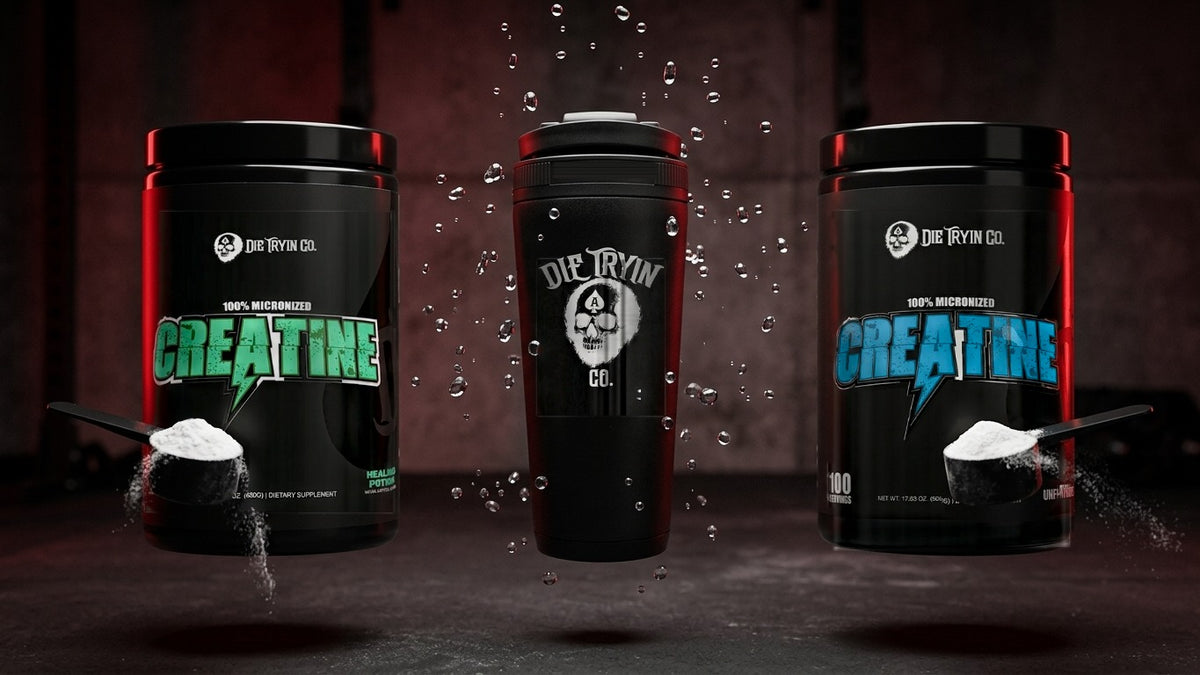
Flavor doesn't change what creatine does; taking it every day is what counts. How to pick flavored or unflavored, what to mix it with, and how long it lasts once mixed.
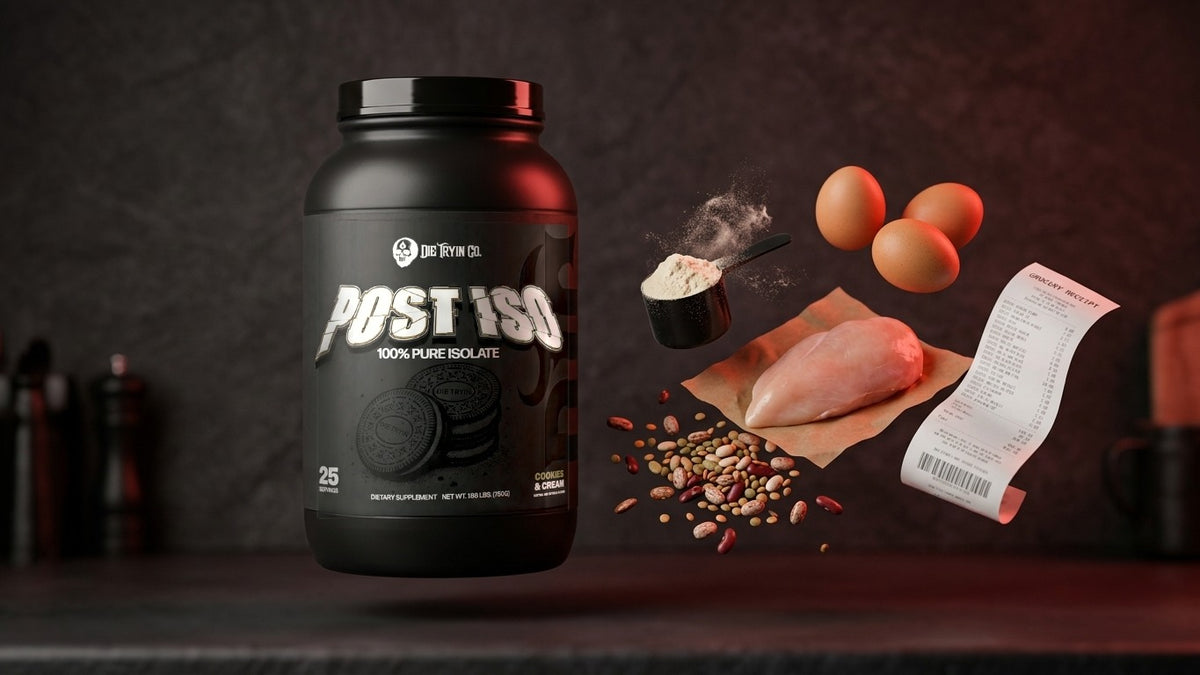
Whey protein concentrate now costs more than four times its early-2023 low. Here is what is driving it, what the 2027 forecasts actually say, and how to pay less per gram of protein without getting...
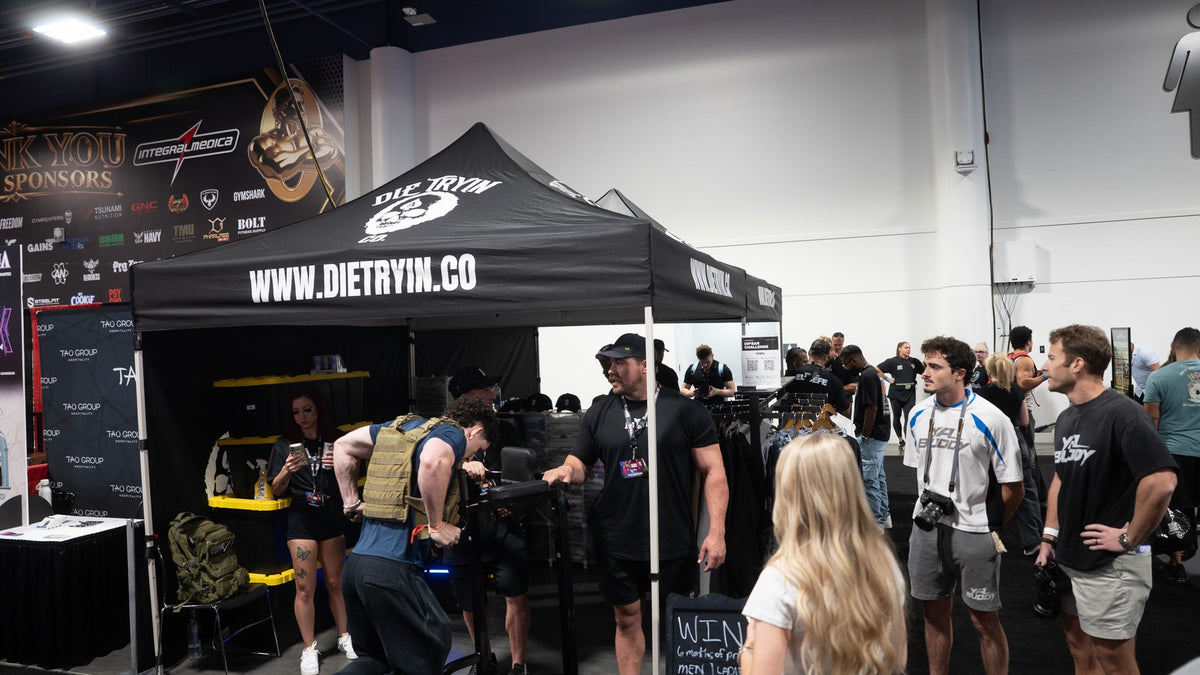
Four days, 1,400 miles on the road, 17 new products and 500 new customers. Here is what went down at the Die Tryin Co. booth at the 2026 Olympia World Fitness Expo.
Two tubs both say 9 g of citrulline. One gives you 9 g, the other gives you 6 g. The 2:1 ratio explained, plus the 2024 trial that tested whether the malate does anything at all.
The honest case for a multivitamin when you train hard: where the evidence stops, where the gaps are real, and why chelated minerals plus a gut stack change the math.
Most people buy carbs, aminos and electrolytes as three separate tubs. Fuel Point 2.0 is one scoop that does all three jobs, with every dose printed where you can read it.