


Betaine Anhydrous
By Jon Klipstein, U.S. Army Combat Veteran & Founder of Die Tryin Co.
Science reviewed by Onur Oncer, BS Physiology and peer-reviewed published researcher.
THE INGREDIENT THAT SHOWS UP ON LEG DAY
Betaine Anhydrous (trimethylglycine) occurs naturally in beets and whole grains, and it does two jobs that matter to a lifter. It acts as an osmolyte, pulling water into cells so they hold volume under load, and as a methyl donor, feeding the reactions that recycle homocysteine into methionine, the same methylation pathway creatine synthesis draws on.
Most people get this wrong. Betaine Anhydrous got filed as a fat-loss ingredient off early, contradictory findings, and that is not where the evidence landed. The honest headline is lower-body strength.
Where it sits in the line, exactly as the labels print it:
| Product | Betaine Anhydrous per serving | Role in the formula |
|---|---|---|
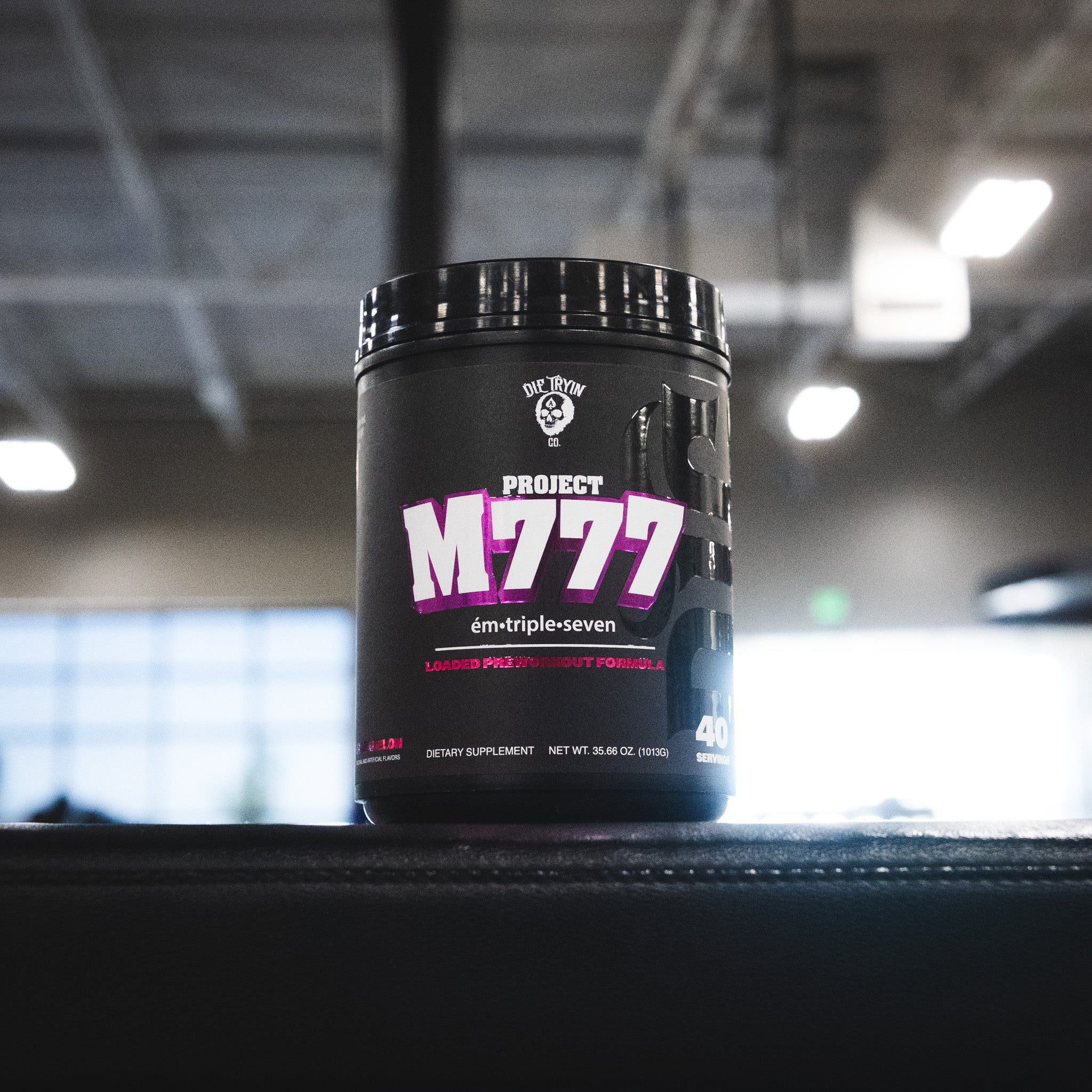
| Project M777 (per scoop) | 2,500 mg (5,000 mg at two scoops) | Full research dose on the hardest days |
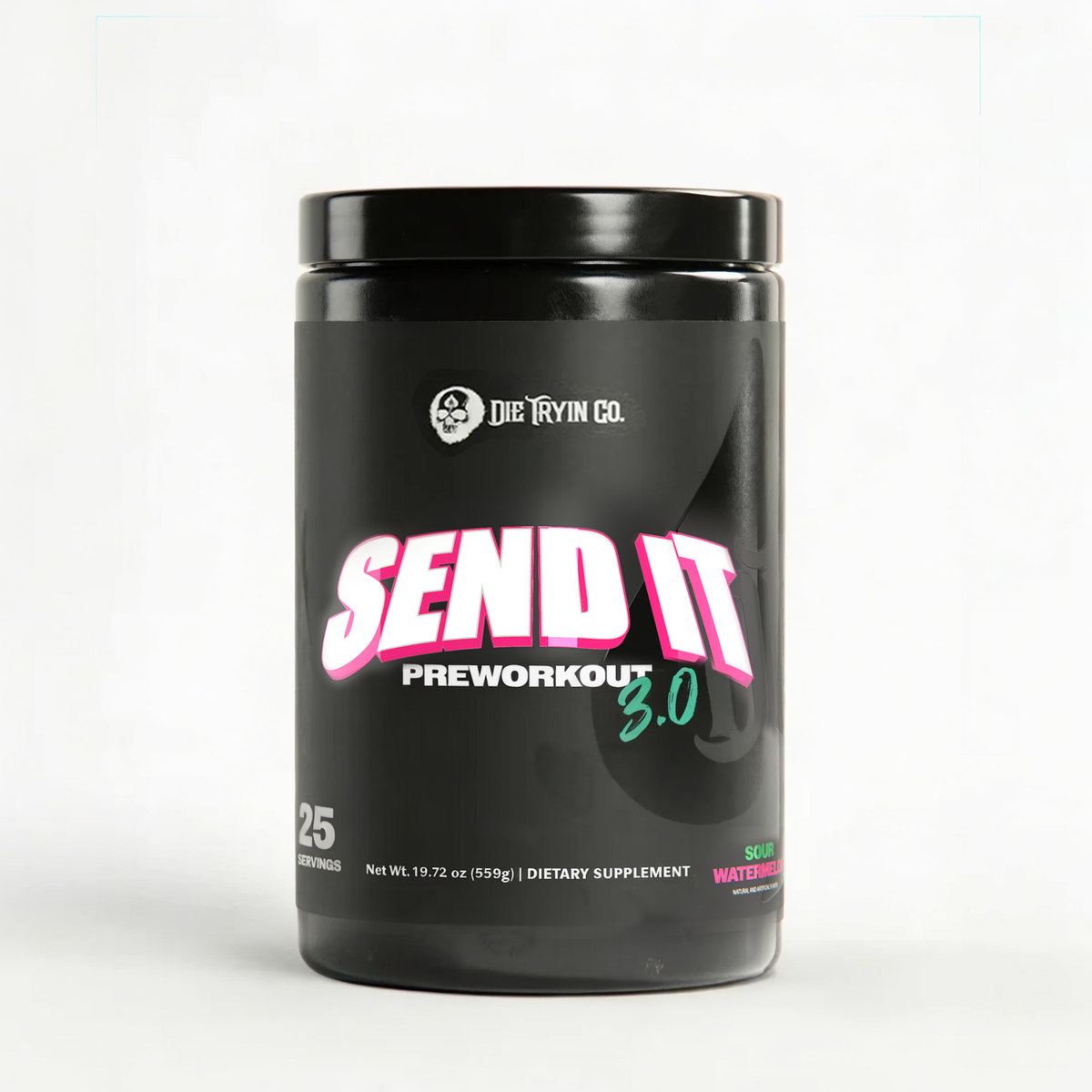
| SEND IT 3.0 | 2,500 mg | Full research dose in the daily driver |
| SEND IT Sport | 1,250 mg | Half dose, in the lower-stim endurance formula |
"Anhydrous" means water-free: the raw material is the compound itself, no hydrate weight and no salt riding along. Betaine HCl, the form sold for digestive support, carries hydrochloric acid that takes up part of every gram. The performance research runs on the anhydrous form, so that is what we buy.
WHAT THE RESEARCH SHOWS
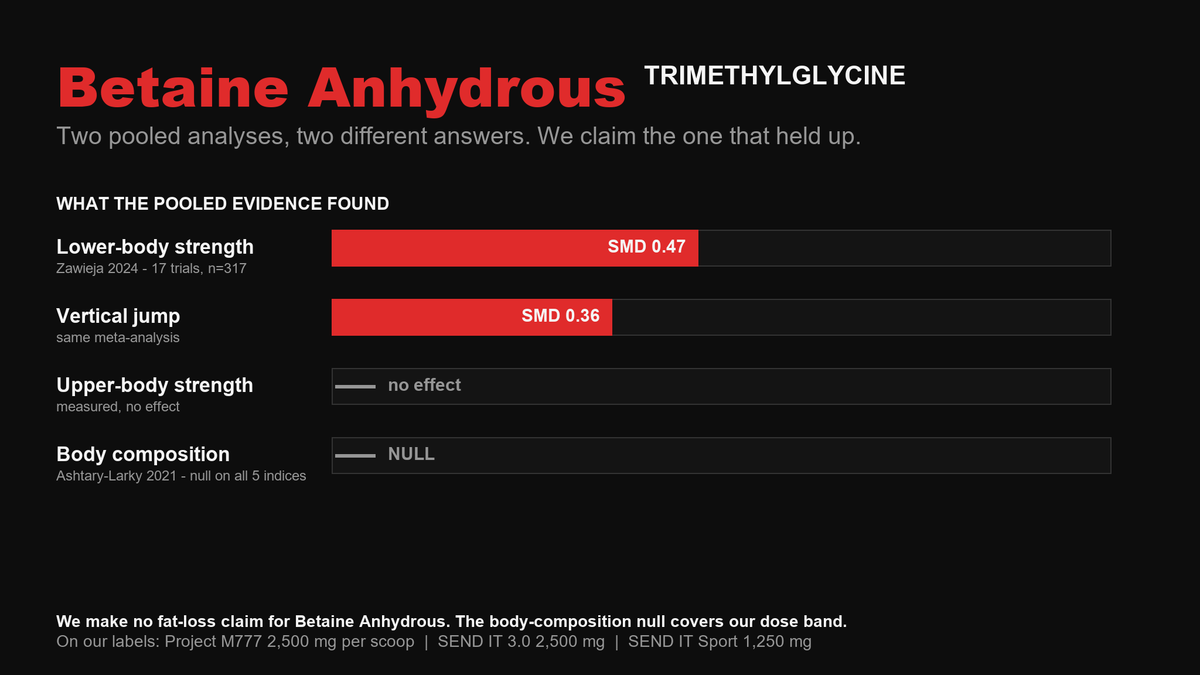
The strongest evidence is a 2024 systematic review and meta-analysis pooling 17 trials and 317 participants. Maximal strength improved, SMD 0.47 (95% CI 0.04 to 0.89), carried by the lower body (SMD 0.49). Vertical jump improved as well (SMD 0.36) once one low-quality study was excluded. The lower bound sits close to zero: a real effect, and a modest one. Every trial in that pool dosed chronically, with the effect reported at seven days and beyond. A daily ingredient, not a first-scoop one.
That same analysis found no significant effect on upper-body strength, cycling sprint power, bench-press-throw power, or muscular endurance. The signal is specific, and we do not round it up.
Where the evidence stops: body composition. A 2021 systematic review and meta-analysis in the British Journal of Nutrition pooled the literature through August 2021 and returned null on all five indices, body mass, BMI, body fat percentage, fat mass and fat-free mass, with every subgroup null, including the under-4 g dose band our 2.5 g sits in. A 2018 randomized trial in 23 untrained women did record greater fat-mass loss on 2.5 g than placebo over eight weeks of lifting; the pooled literature did not follow it. We make no fat-loss or recomposition claim for Betaine Anhydrous, and we link the study that cuts the other way rather than lead with it.
On dose, the two numbers line up cleanly:
| Dose | What the number counts | |
|---|---|---|
| In the trials | 2.5 g per day, 7 days minimum | Betaine Anhydrous, as the trials dosed it |
| On our labels | 2,500 mg (M777 per scoop, SEND IT 3.0) · 1,250 mg (SEND IT Sport) | Betaine Anhydrous, the same water-free form |
No conversion math: anhydrous is the compound, so the milligrams printed are the milligrams you get. SEND IT Sport runs lower-stim for long sessions, and we would rather print the half dose and call it half. Mechanism worth formulating on, human data disclosed with its boundaries, a label you can check.
WHY MOST PRE-WORKOUTS LEAVE IT OUT
Betaine Anhydrous has no tingle and no rush. Nothing about it announces itself in the first ten minutes, so formulas built around the feeling of a pre-workout skip it and formulas built around output do not. At 2,500 mg a serving it costs real money, and it is the first line item cut when the budget leads.
The measured effect lands in the lower body. The squat 1RM plan handles the programming side; the complete pre-workout guide covers where this ingredient sits in a formula.
FREQUENTLY ASKED QUESTIONS
What is Betaine Anhydrous?
Trimethylglycine in its water-free form, found naturally in beets and whole grains. It works as an osmolyte that helps cells hold water under load, and as a methyl donor in the methionine cycle.
What dose does the research use?
2.5 g per day is the dose used across the trials, taken daily for at least seven days before the effect is reported. Project M777 and SEND IT 3.0 both carry 2,500 mg per serving; SEND IT Sport carries 1,250 mg.
Does Betaine Anhydrous help with fat loss?
No, and we do not claim one. The 2021 pooled analysis found no effect on body mass, BMI, body fat percentage, fat mass or fat-free mass, and the null held across every subgroup, including the dose band our 2.5 g sits in. It is in these formulas for lower-body strength.
Betaine Anhydrous vs Betaine HCl, what's the difference?
Different raw materials. The anhydrous form is the compound on its own, and it is what the performance research runs on. Betaine HCl is bound to hydrochloric acid and sold for digestive support. When a label just says "betaine," check which one is in the tub.
READY TO GEAR UP?
Every dose above is printed on the label, in the form you actually receive. See every ingredient we use in the Ingredient Index, or take the 60-second quiz to match a formula to your training.
ALWAYS FORWARD.
Read more
Flavor doesn't change what creatine does; taking it every day is what counts. How to pick flavored or unflavored, what to mix it with, and how long it lasts once mixed.
Whey protein concentrate now costs more than four times its early-2023 low. Here is what is driving it, what the 2027 forecasts actually say, and how to pay less per gram of protein without getting...
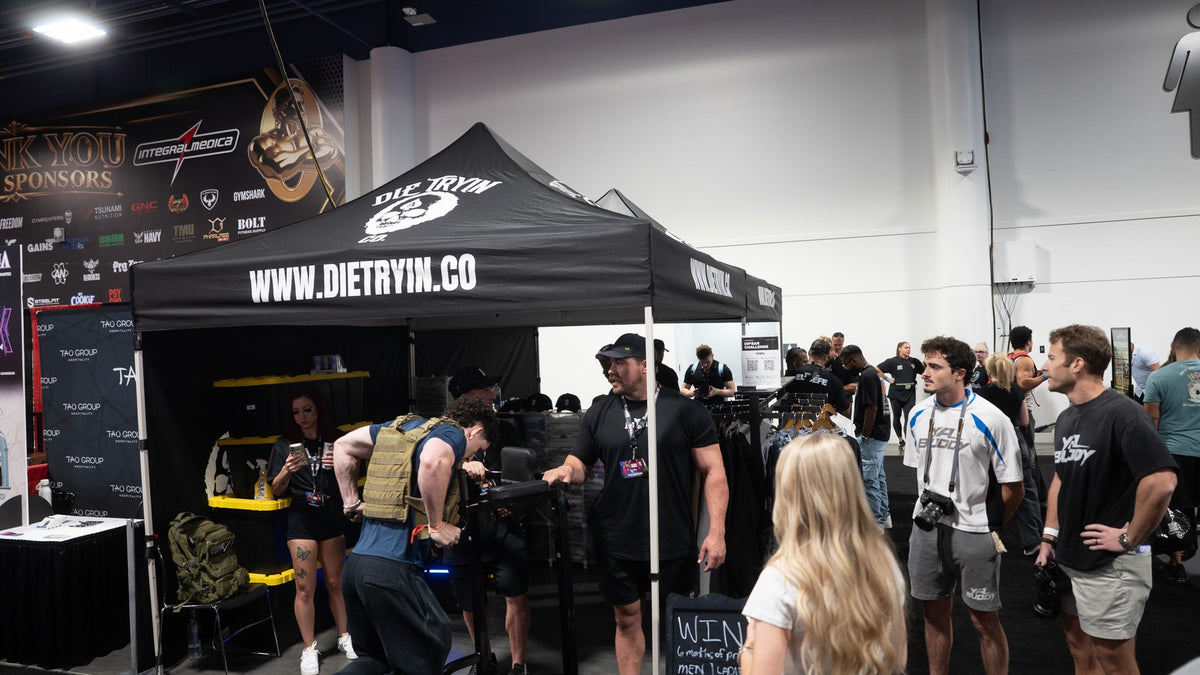
Four days, 1,400 miles on the road, 17 new products and 500 new customers. Here is what went down at the Die Tryin Co. booth at the 2026 Olympia World Fitness Expo.
Two tubs both say 9 g of citrulline. One gives you 9 g, the other gives you 6 g. The 2:1 ratio explained, plus the 2024 trial that tested whether the malate does anything at all.
The honest case for a multivitamin when you train hard: where the evidence stops, where the gaps are real, and why chelated minerals plus a gut stack change the math.
Most people buy carbs, aminos and electrolytes as three separate tubs. Fuel Point 2.0 is one scoop that does all three jobs, with every dose printed where you can read it.